Research groups
Assign stove construction waves by lottery
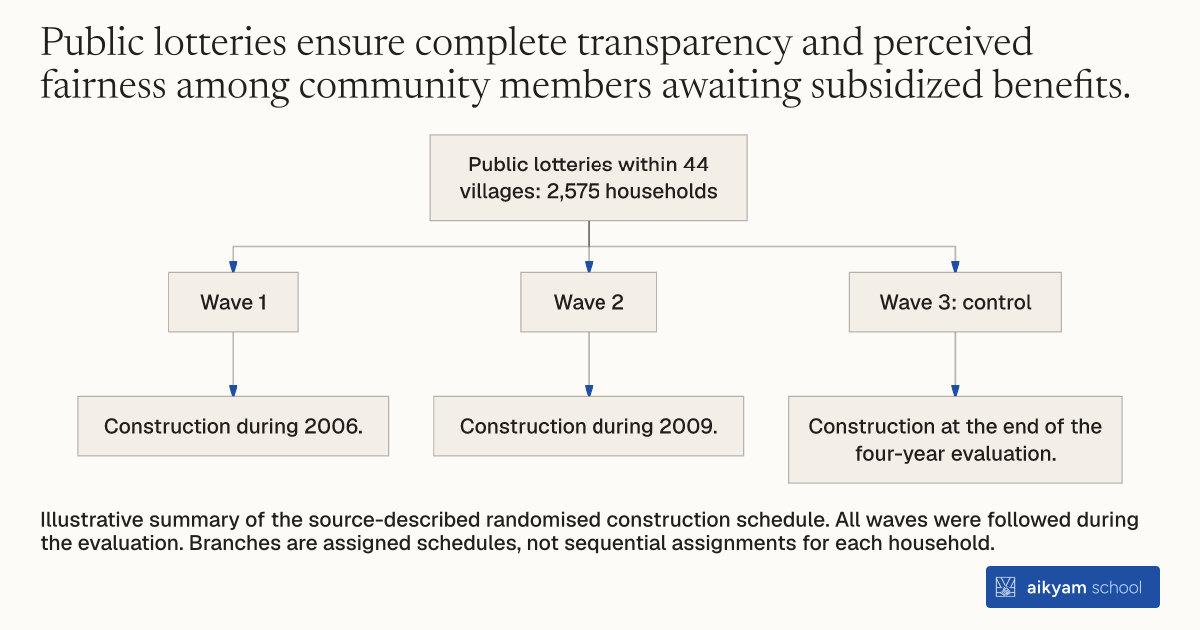
Public lotteries within 44 villages: 2,575 households
- Wave 1
- Construction during 2006.
- Wave 2
- Construction during 2009.
- Wave 3: control
- Construction at the end of the four-year evaluation.
Illustrative summary of the source-described randomised construction schedule. All waves were followed during the evaluation. Branches are assigned schedules, not sequential assignments for each household.
See source →How
When to use
Evaluating a large-scale public health intervention across thousands of rural households requires a transparent and unbiased assignment mechanism. Non-random distribution risks selection bias and community resentment when resources are limited. Program evaluators deploy public lotteries to randomly phase in construction waves across target communities over multiple years.
Randomly assign the order of stove construction within target villages using public lotteries to stagger intervention waves over time.
- Evaluators enroll all 2,575 eligible households across 44 target villages in Orissa, India.
- Evaluators conduct public lotteries within each village to randomly assign the construction order for enrolled households.
- Program staff construct improved cookstoves for wave 1 winning households during 2006.
- Program staff construct cookstoves for wave 2 winning households during 2009.
- Program staff construct cookstoves for wave 3 control households at the end of the four-year evaluation period.
- Evaluators follow households across all construction waves for four years after initial stove offers to track long-run impacts.
Why it works
Staggering construction into randomized waves maintains robust comparison groups to allow rigorous impact evaluation over long time horizons.
Example
Researchers and local partner Gram Vikas used public lotteries in Orissa, India to assign cookstove construction across 2,575 households in 44 villages. Stoves were distributed in three waves (2006, 2009, and end of study), enabling evaluators to track adoption and health outcomes for four years following initial offers.
About the study
Participants
2,575 households in 44 rural villages, Orissa, India.
Study Design
Four-year longitudinal Randomized Controlled Trial (RCT) using public lotteries to assign three staggered construction waves (2006, 2009, and study end).
Results
Public lotteries successfully randomized stove distribution across 2,575 households, creating wave 1 treatment households who were 62 percent more likely to have an improved stove in years one and two compared to comparison households.