Research procedure
Run community then household lotteries
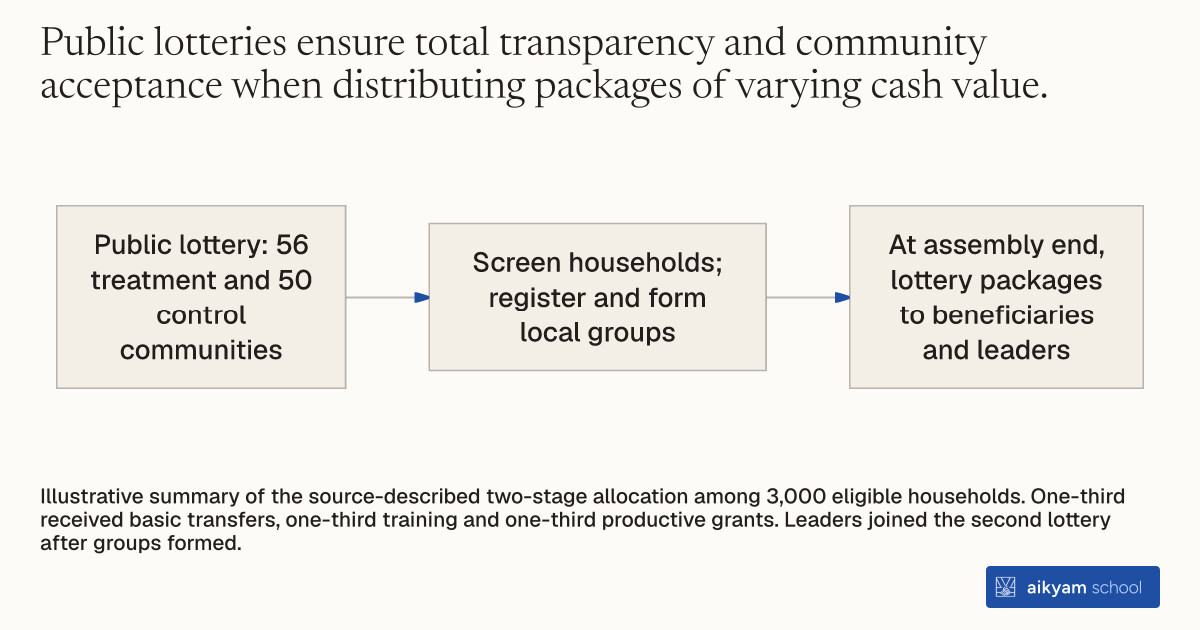
- Public lottery: 56 treatment and 50 control communities
- Screen households; register and form local groups
- At assembly end, lottery packages to beneficiaries and leaders
Illustrative summary of the source-described two-stage allocation among 3,000 eligible households. One-third received basic transfers, one-third training and one-third productive grants. Leaders joined the second lottery after groups formed.
See source →How
When to use
Social protection programs must allocate varying benefit packages fairly across target communities to prevent perceived favoritism. Opaque distribution mechanisms create community dissatisfaction and compromise evaluation design. Apply this method when distributing multiple assistance packages among eligible rural households.
Allocate treatment packages across communities and eligible households using a transparent two-stage public lottery process.
- Hold a public lottery to assign targeted communities to either intervention or control status.
- Select eligible households in intervention communities through objective proxy means baseline assessment.
- Convene registration assemblies in intervention communities with eligible household representatives.
- Form small local beneficiary groups around self-selected female leaders during each assembly.
- Conduct a second public lottery at the end of each assembly to randomly assign benefit packages to all beneficiaries and leaders.
Why it works
Randomizing both leaders and beneficiaries generates exogenous variation in local exposure to successful peers.
Example
In 2006, the Ministry of the Family in Nicaragua conducted a first lottery selecting 56 intervention and 50 control communities, followed by assembly lotteries that assigned packages equally among 3,000 eligible households.
About the study
Participants
3,000 eligible poor households across 56 treatment and 50 control communities in 6 municipalities of northwestern Nicaragua.
Study Design
Two-stage randomized controlled trial assigning communities to treatment or control in the first stage, and assigning individual transfer packages via public lotteries in registration assemblies in the second stage.
Results
The lotteries assigned one-third of households to the basic transfer, one-third to training, and one-third to productive grants, resulting in zero attrition bias across assigned groups.