Procedure
Cluster seed demonstrations
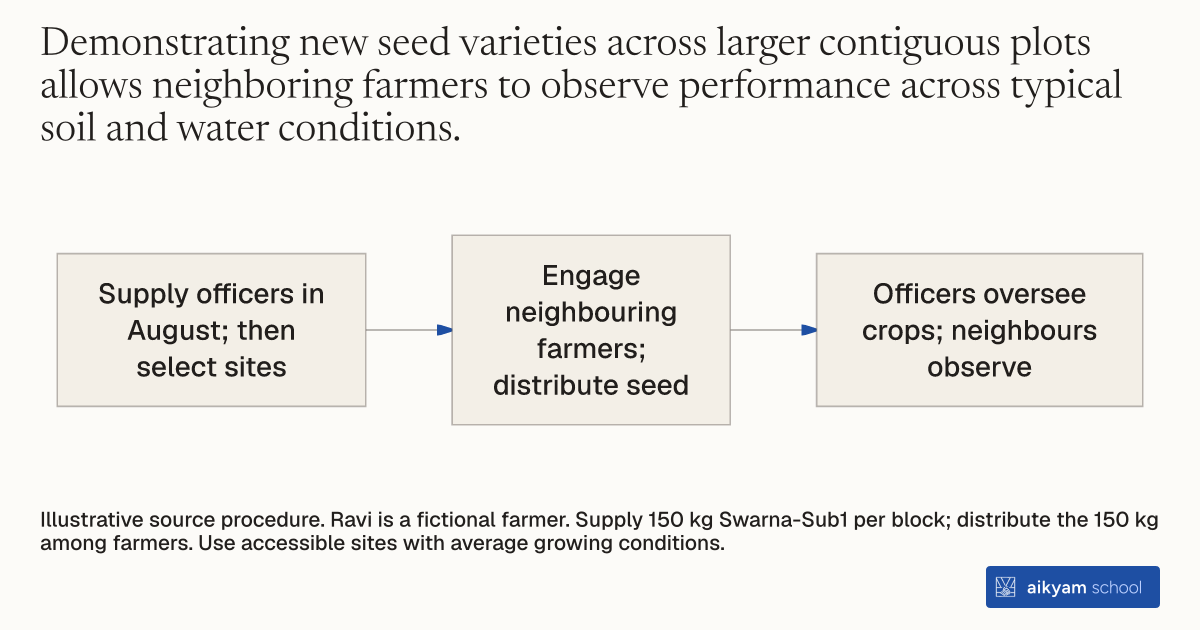
- Supply officers in August; then select sites
- Engage neighbouring farmers; distribute seed
- Officers oversee crops; neighbours observe
Illustrative source procedure. Ravi is a fictional farmer. Supply 150 kg Swarna-Sub1 per block; distribute the 150 kg among farmers. Use accessible sites with average growing conditions.
See source →How
When to use
Smallholder farmers in flood-prone regions often lack exposure to flood-tolerant crop varieties across larger field plots. Public agricultural extension attempts to demonstrate variety performance by planting multi-farm demonstration plots in accessible rural areas. Extension agents conduct these cluster demonstrations to showcase yield resilience under real community growing conditions.
Organize large-scale cluster demonstration plots using public extension agents to showcase new crop varieties across contiguous farmer fields.
- Supply government agricultural extension officers with 150 kilograms of Swarna-Sub1 flood-tolerant rice seeds per target block in August.
- Select accessible demonstration sites that represent average growing conditions across contiguous neighboring farmer plots.
- Identify and engage groups of local farmers with neighboring plots to participate in the cluster demonstration.
- Distribute the 150 kilograms of seeds among the participating cluster farmers to plant the demonstration plots.
- Oversee cultivation through extension officers so nearby farmers observe crop performance under local conditions.
Why it works
Seeing real field results encourages surrounding community members to adopt the variety on their own land.
Example
Government extension officers in Odisha, India received 150 kg of Swarna-Sub1 seeds in August 2016 to set up cluster demonstrations across 36 administrative blocks. These demonstrations formed part of the standard public extension comparison group that achieved a 6.3 percent farmer adoption rate 15 months later.
About the study
Participants
36 administrative blocks comprising about 136 villages each across 10 flood-prone coastal districts in Odisha, India, targeting smallholder farmers.
Study Design
Randomized controlled trial evaluating standard public extension practices—including 150 kg seed cluster demonstrations, 5 kg individual seed kits, and farmer field days—against an agro-dealer extension model across 72 blocks between 2016 and 2018.
Results
Cluster demonstrations contributed to a baseline Swarna-Sub1 adoption rate of 6.3 percent among farmers after 15 months, trailing the agro-dealer extension group by 3.5 percentage points (a 56 percent lower adoption rate) and generating an average cultivated area of 0.09 acres per farmer.