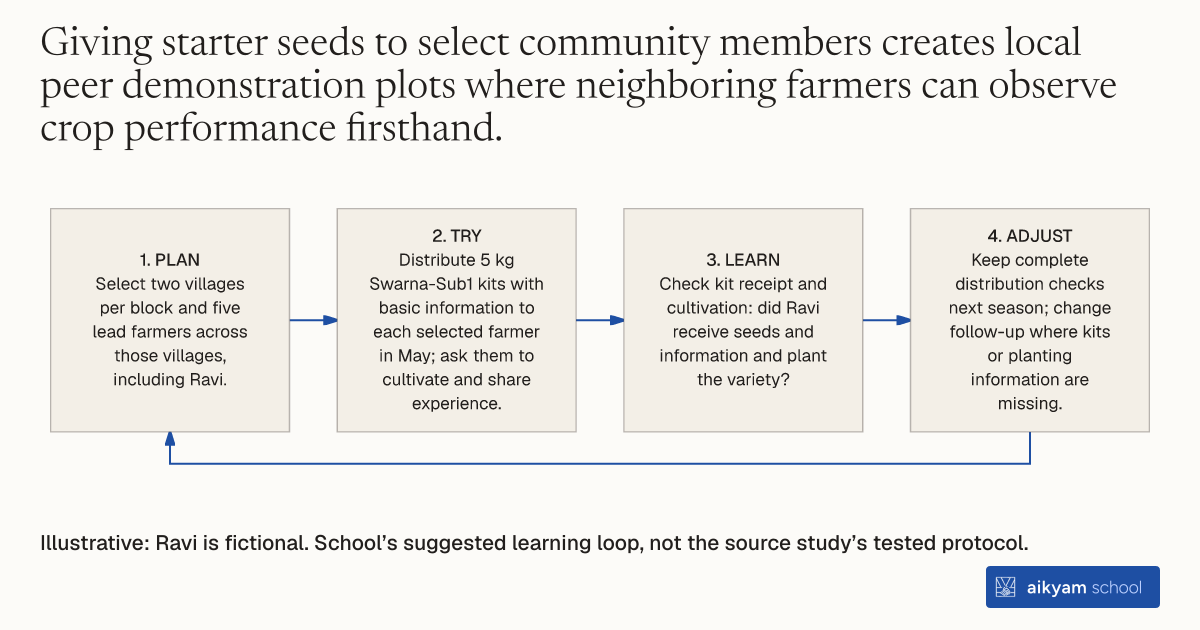
Try, learn and adjust
Check lead farmers receive seed kits
- Plan: Select two villages per block and five lead farmers across those villages, including Ravi.
- Try: Distribute 5 kg Swarna-Sub1 kits with basic information to each selected farmer in May; ask them to cultivate and share experience.
- Learn: Check kit receipt and cultivation: did Ravi receive seeds and information and plant the variety?
- Adjust: Keep complete distribution checks next season; change follow-up where kits or planting information are missing.
Illustrative: Ravi is fictional. School’s suggested learning loop, not the source study’s tested protocol.
See source →School’s suggested, untested learning loop. Observe seed receipt, cultivation and shared experience; programme adoption results do not isolate seed-kit effects.
How
When to use
Smallholder farmers in flood-prone regions often lack awareness of improved crop varieties like flood-tolerant rice. Traditional public extension programs attempt to solve this by providing starter seed samples to select lead farmers in rural villages. These lead farmers are expected to cultivate the variety and share their experience and seed stock with neighboring community members.
Distribute basic information and small trial seed kits to select lead farmers through public extension agents before the planting season.
- Assign government agricultural extension agents to target rural administrative blocks.
- Prepare trial seed kits containing basic informational materials and 5 kilograms of Swarna-Sub1 flood-tolerant rice seeds.
- Select two representative villages within each administrative block.
- Distribute five seed kits to five individual farmers across the two selected villages in May where the source specifies.
- Instruct lead farmers to cultivate the seeds and share knowledge and harvest outcomes with nearby community members.
Why it works
Neighboring farmers learn about the variety's stress tolerance and obtain informal seed sharing from lead farmers.
Example
Government extension agents in Odisha, India distributed 5 kg seed kits of Swarna-Sub1 rice and basic informational materials to five farmers across two villages per block in 36 administrative blocks in May 2016. Fifteen months later, farmer adoption reached 6.3 percent in these comparison blocks, providing a baseline rate for evaluating alternative extension strategies.
About the study
Participants
36 administrative blocks comprising about 136 villages each across 10 flood-prone coastal districts in Odisha, India, targeting smallholder farmers.
Study Design
Randomized controlled trial evaluation where government extension agents distributed 5 kg seed kits to five farmers in two villages per block, evaluated after 15 months alongside cluster demonstrations and farmer field days against an agro-dealer extension arm.
Results
Public lead-farmer seed kit distribution contributed to a baseline Swarna-Sub1 adoption rate of 6.3 percent among farmers 15 months post-intervention, underperforming dealer-focused extension by 3.5 percentage points (a 56 percent difference), with average cultivation reaching 0.09 acres per farmer.