Try, learn and adjust
Check the field day uses local observations
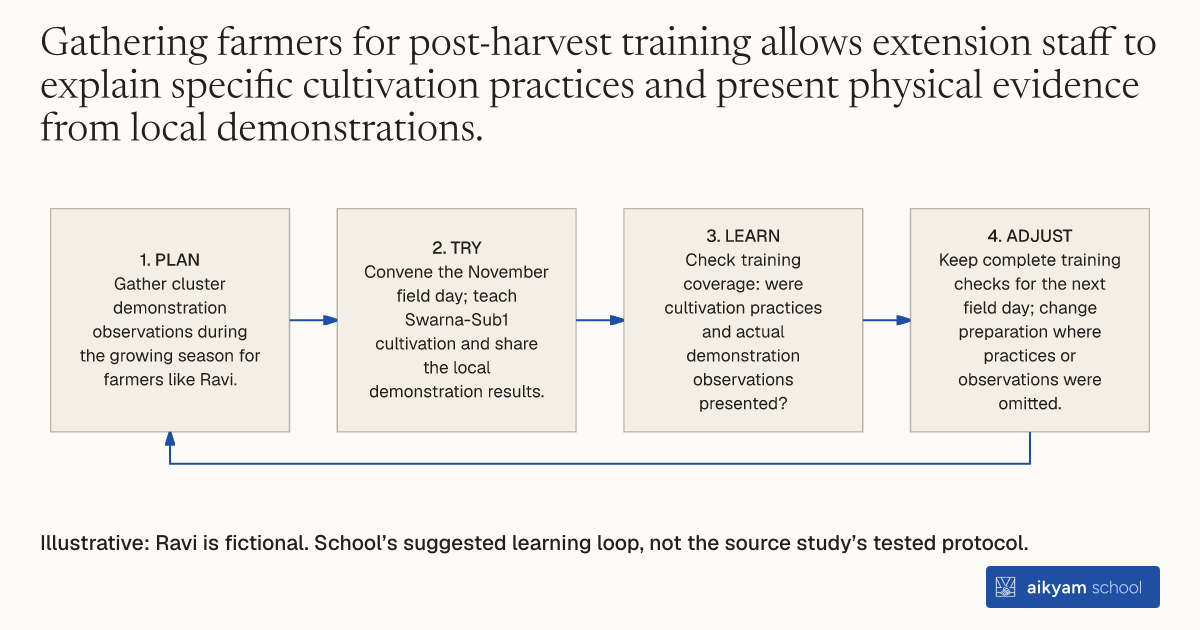
- Plan: Gather cluster demonstration observations during the growing season for farmers like Ravi.
- Try: Convene the November field day; teach Swarna-Sub1 cultivation and share the local demonstration results.
- Learn: Check training coverage: were cultivation practices and actual demonstration observations presented?
- Adjust: Keep complete training checks for the next field day; change preparation where practices or observations were omitted.
Illustrative: Ravi is fictional. School’s suggested learning loop, not the source study’s tested protocol.
See source →School’s suggested, untested learning loop. Observe training content and demonstration evidence; field days were part of a broader public extension package.
How
When to use
Smallholder farmers in flood-prone areas often lack practical knowledge on how to cultivate and maximize yields from new crop varieties like flood-tolerant rice. Traditional public extension systems address this knowledge gap by convening village gathering events called farmer field days. At these events, extension staff train local farmers on crop management techniques and share performance results from nearby field demonstrations.
Organize end-of-season farmer field days where public extension staff train local farmers on crop management and share demonstration results.
- Assign government extension officers to manage target rural administrative blocks.
- Oversee local cluster demonstrations throughout the growing season to gather crop performance observations.
- Convene local farmers for public field day events in November after the growing season.
- Provide structured training to assembled farmers regarding proper Swarna-Sub1 seed use and cultivation practices.
- Present outcomes and yield evidence from local cluster demonstrations to motivate farmers to adopt the variety.
Why it works
Seeing real demonstration outcomes and receiving expert instructions builds farmer confidence in adopting new agricultural technologies.
Example
Government extension officers in Odisha, India organized farmer field days in November 2016 across 36 administrative blocks to train farmers on Swarna-Sub1 rice use and present findings from cluster demonstrations. These field days formed part of a standard public extension approach that achieved a 6.3 percent farmer adoption rate 15 months post-intervention.
About the study
Participants
36 administrative blocks comprising about 136 villages each across 10 flood-prone coastal districts in Odisha, India, targeting smallholder farmers.
Study Design
Randomized controlled trial comparing standard public extension practices—including November farmer field days, 150 kg cluster demonstrations, and 5 kg seed kits—against an agro-dealer extension model evaluated after 15 months.
Results
Farmer field days contributed to a baseline Swarna-Sub1 adoption rate of 6.3 percent among farmers after 15 months, underperforming agro-dealer extension by 3.5 percentage points (a 56 percent difference) and achieving 0.09 acres of cultivation per farmer.