Research procedure
Describe the national-policy campaign arm
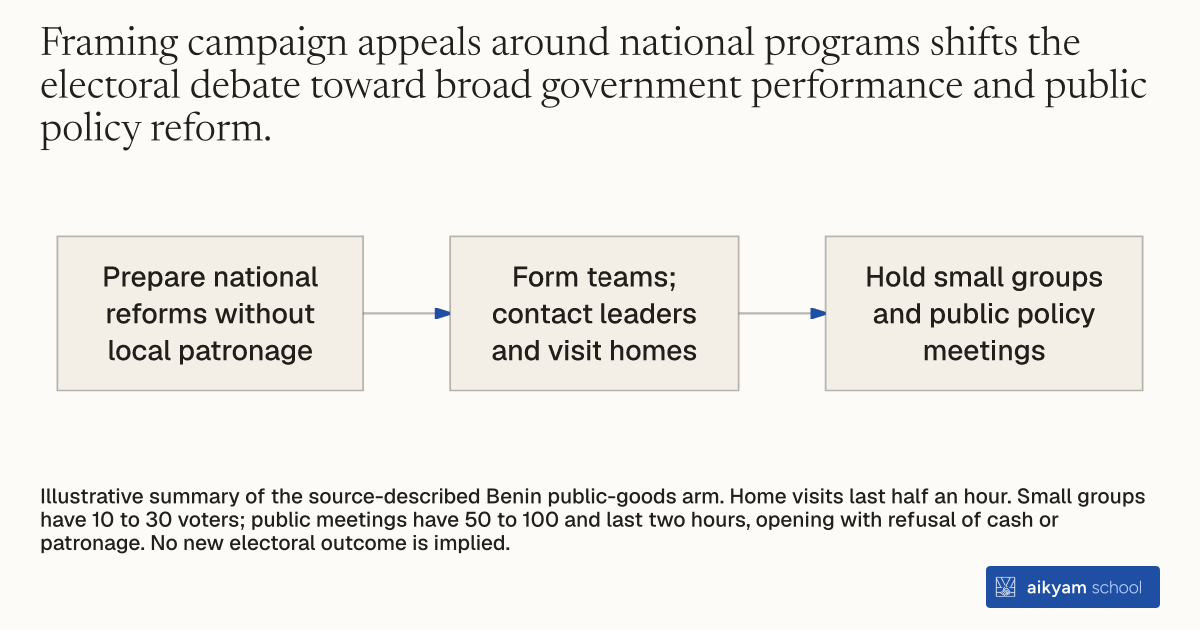
- Prepare national reforms without local patronage
- Form teams; contact leaders and visit homes
- Hold small groups and public policy meetings
Illustrative summary of the source-described Benin public-goods arm. Home visits last half an hour. Small groups have 10 to 30 voters; public meetings have 50 to 100 and last two hours, opening with refusal of cash or patronage. No new electoral outcome is implied.
See source →How
When to use
Political parties face voters who expect localized clientelist favors or private payouts during electoral campaigns. Candidates need a structured platform format to communicate national public goods policies such as health reform, education, and infrastructure. This method applies to electoral campaigns in developing democracies aiming to test public policy appeals against traditional clientelism.
Deliver a national public goods platform to voters using standardized non-patronage campaign meetings and household visits.
- Draft a campaign platform focused strictly on nationwide policy reforms in health, education, and agriculture without promising local favors or patronage jobs.
- Form campaign teams consisting of party representatives and a research assistant serving as a campaign worker.
- Settle in assigned villages and contact local administrative, religious, and traditional authorities.
- Conduct half-hour home visits to influential local figures to present the national policy program.
- Host small group meetings of 10 to 30 voters at local cultural or sporting events.
- Hold two-hour public meetings of 50 to 100 voters, opening with an explicit refusal to offer cash or patronage, followed by detailed policy discussions.
Why it works
Voters evaluate policy proposals based on credible national governance rather than localized patronage promises.
Example
During the March 2001 presidential election in Benin, campaign teams delivered pure public goods platforms in 12 villages across 6 electoral districts. The campaign reached 4,784 registered voters with non-patronage national policy proposals.
About the study
Participants
4,784 registered voters across 12 randomized treatment villages in 6 electoral districts in Benin during the March 2001 presidential election.
Study Design
Randomized block experiment comparing villages assigned to a pure national public goods campaign platform against clientelist treatment villages and standard control villages, evaluated using a post-election survey of randomly sampled households.
Results
Exposure to pure public goods platforms reduced overall voting probability for the dominant candidate by 12 to 24 percentage points compared to control, but increased voting probability by 5 to 8 percentage points among primary-educated voters and by 12 to 16 percentage points among co-ethnic voters.