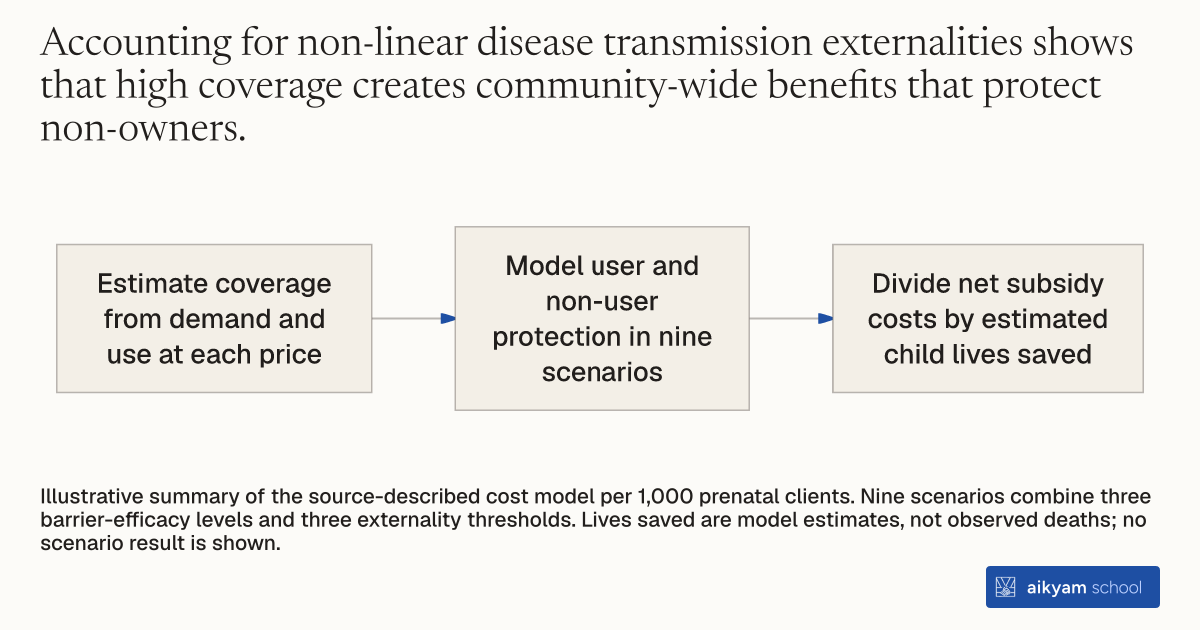
Research cost model
Compare modeled costs per child life saved
- Estimate coverage from demand and use at each price
- Model user and non-user protection in nine scenarios
- Divide net subsidy costs by estimated child lives saved
Illustrative summary of the source-described cost model per 1,000 prenatal clients. Nine scenarios combine three barrier-efficacy levels and three externality thresholds. Lives saved are model estimates, not observed deaths; no scenario result is shown.
See source →How
When to use
Policy makers evaluating health product subsidies must weigh budget costs against public health gains. Standard cost calculations often ignore community-wide disease reduction generated when coverage exceeds clinical thresholds. Incorporating herd protection externalities into cost-effectiveness models reveals the true cost per life saved under free distribution versus partial cost-sharing.
Calculate the net cost per child life saved across subsidy levels by modeling both direct physical barrier protection and indirect coverage externalities.
- Combine empirical price elasticity of demand and usage estimates to calculate population coverage rates at each subsidy level.
- Construct a user protection index combining direct physical barrier protection and local mosquito density reduction.
- Build a non-user protection index using a logistic function based on the total share of bed net users in the community.
- Calculate child lives saved per 1,000 prenatal clients under nine sensitivity scenarios varying physical barrier efficacy and externality threshold levels.
- Estimate public subsidy costs per net distributed minus revenue collected from client fees at each price point.
- Divide net program costs by estimated child lives saved to derive the cost per life saved for each pricing scheme.
Why it works
High subsidies maximize overall health impacts, reducing the cost per life saved despite higher public expenditures per net.
Example
Researchers modeled the cost-effectiveness of bed net distribution across 20 prenatal clinics in western Kenya under four price levels. Free distribution saved 11 to 38 child lives per 1,000 clients compared to 4 to 16 lives under a 90 percent subsidy (40 shillings), achieving a lower or comparable cost per life saved across most scenarios.
About the study
Participants
545 pregnant women across 20 public health clinics in western Kenya, plus cost modeling covering 1,000 prenatal clients per scenario.
Study Design
Economic cost-effectiveness model combining experimental demand and usage elasticities with epidemiological protection functions across 9 sensitivity scenarios (3 physical barrier levels × 3 externality thresholds).
Results
Free distribution saved 38 child lives per 1,000 clients under high externality assumptions (costing $200 per life saved), whereas charging 40 Kenyan shillings saved only 16 lives (costing $175 to $302 per life saved).