Try, learn and adjust
Check displayed net prices match recorded distribution
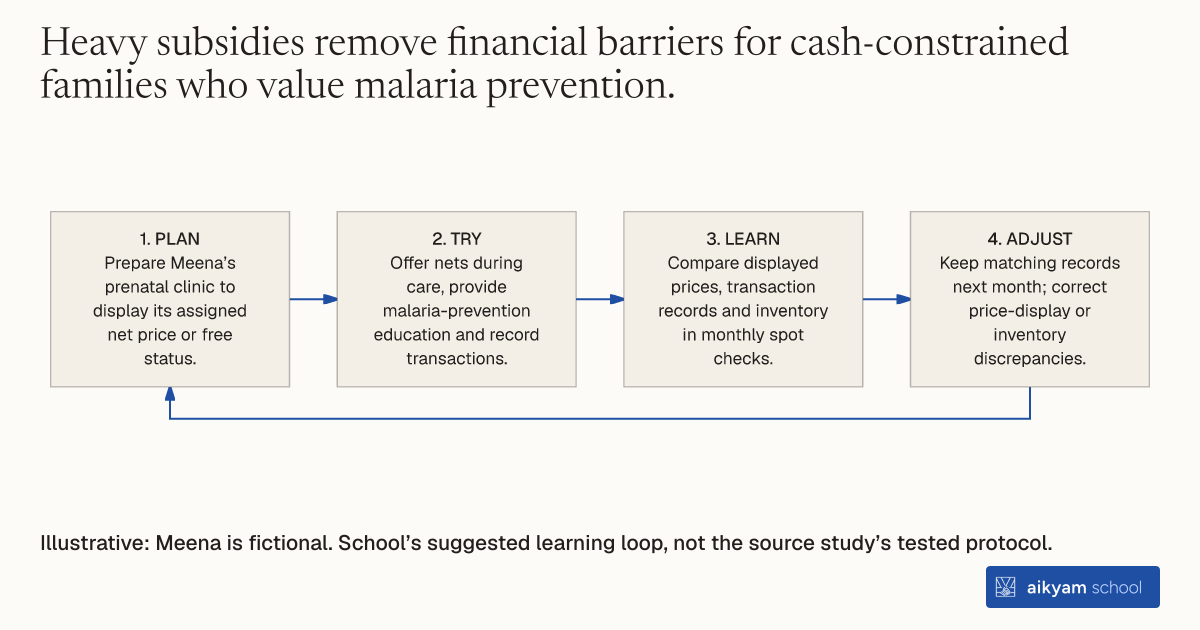
- Plan: Prepare Meena’s prenatal clinic to display its assigned net price or free status.
- Try: Offer nets during care, provide malaria-prevention education and record transactions.
- Learn: Compare displayed prices, transaction records and inventory in monthly spot checks.
- Adjust: Keep matching records next month; correct price-display or inventory discrepancies.
Illustrative: Meena is fictional. School’s suggested learning loop, not the source study’s tested protocol.
See source →Posted prices, transactions and stocks; the study tested 0, 10, 20 and 40 KES. School’s suggested learning loop, not a source-tested cycle.
How
When to use
Pregnant women and young children in malaria-endemic regions face high risks of disease and maternal anemia. Subsidizing long-lasting insecticide-treated bed nets through local health centers helps overcome severe financial barriers. Public health programs use this approach to maximize net coverage and protect vulnerable populations.
Distribute long-lasting insecticide-treated bed nets to pregnant women visiting rural prenatal clinics at specified subsidy levels or free of charge.
- Clinic health workers offer long-lasting insecticide-treated bed nets to expectant mothers during routine prenatal care visits.
- Display prominent posters in clinic waiting areas to state the required price or free status of the bed nets clearly.
- Health workers record each transaction in administrative registers to log net sales and patient attendance.
- Staff provide routine health education on the importance of malaria prevention and bed net usage during check-ups.
- Program administrators conduct random monthly spot checks of clinic record books to ensure proper inventory accounting.
Why it works
Full subsidization maximizes overall coverage, triggering community-wide health externalities that protect users and non-users alike.
Example
Researchers partnered with 20 public health clinics across four districts in western Kenya to test bed net prices ranging from free to 40 Kenyan shillings ($0.60). Uptake reached 99 percent under free distribution, but dropped to 39 percent when the price increased to 40 shillings.
About the study
Participants
545 pregnant women surveyed across 16 program public health centers in Busia, Bungoma, Butere, and Mumias districts in western Kenya.
Study Design
Randomized controlled trial across 20 public health clinics randomly assigned to control or four price levels (0, 10, 20, or 40 Kenyan shillings), measuring uptake and subsequent home usage.
Results
Increasing the price from 0 to 40 Kenyan shillings reduced bed net uptake by 60 percentage points and effective coverage from 65 percent to 15 percent.