Try, learn and adjust
Check weekly public job-search support
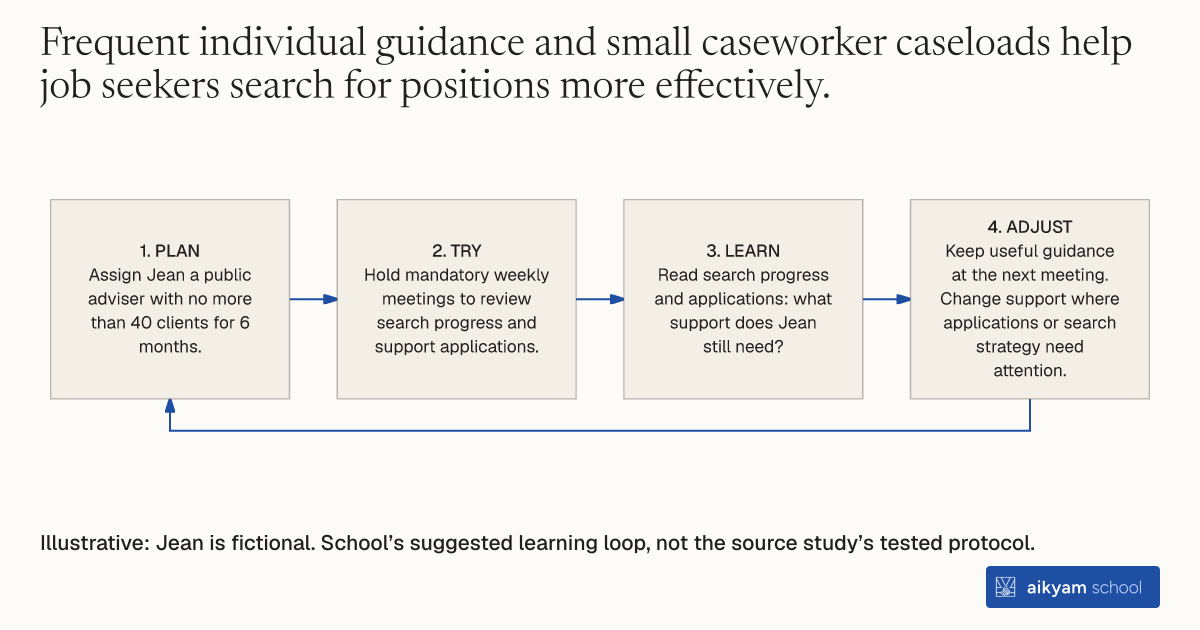
- Plan: Assign Jean a public adviser with no more than 40 clients for 6 months.
- Try: Hold mandatory weekly meetings to review search progress and support applications.
- Learn: Read search progress and applications: what support does Jean still need?
- Adjust: Keep useful guidance at the next meeting. Change support where applications or search strategy need attention.
Illustrative: Jean is fictional. School’s suggested learning loop, not the source study’s tested protocol.
See source →School’s suggested learning loop: observe weekly meetings, search progress and applications. Do not infer job placement from meeting attendance.
How
When to use
Governments face rising long-term unemployment among workers entitled to unemployment benefits. Standard public employment agencies often assign high client caseloads to advisors, reducing individual attention. Public intensive job search counseling provides personalized, high-frequency support to accelerate employment transitions.
Assign job seekers at risk of long-term unemployment to dedicated public advisors with low caseloads for six months.
- Assign each public personal advisor a maximum caseload of 40 clients at local employment offices.
- Schedule mandatory individual counseling meetings on a weekly basis to review search progress.
- Provide personal support on job search strategy and application submissions throughout the six-month period.
Why it works
Regular monitoring encourages consistent application effort and maintains momentum during unemployment spells.
Example
ANPE launched an intensive counseling program in 2007 across 216 public employment offices in four French administrative regions. Assigned advisors worked with a maximum of 40 clients in weekly meetings for six months at an estimated cost of €657 per client.
About the study
Participants
Nearly 44,000 job seekers entering unemployment and entitled to at least one year of benefits across 216 local public employment offices in four French administrative regions.
Study Design
Randomized controlled trial conducted from January to December 2007 tracking administrative and survey data over 12 months across public intensive, private intensive, and public standard comparison groups.
Results
Within six months, the public intensive program increased the probability of exiting unemployment and finding a job by 50 percent, representing a 10.2 percentage point increase from a base of 20.7 percent. It increased the likelihood of finding a job lasting at least six months by 34 percent, a 7.2 percentage point increase compared to the counterfactual.