Try, learn and adjust
Check access to report cards through public readings
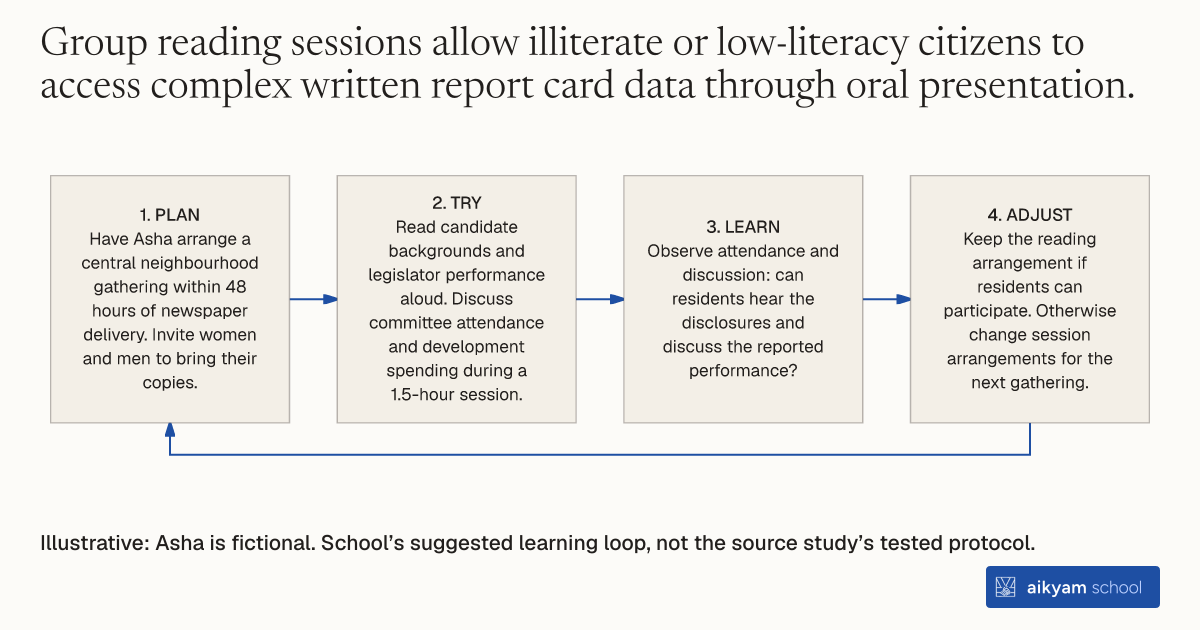
- Plan: Have Asha arrange a central neighbourhood gathering within 48 hours of newspaper delivery. Invite women and men to bring their copies.
- Try: Read candidate backgrounds and legislator performance aloud. Discuss committee attendance and development spending during a 1.5-hour session.
- Learn: Observe attendance and discussion: can residents hear the disclosures and discuss the reported performance?
- Adjust: Keep the reading arrangement if residents can participate. Otherwise change session arrangements for the next gathering.
Illustrative: Asha is fictional. School’s suggested learning loop, not the source study’s tested protocol.
See source →School’s suggested, untested loop: observe access to the reading and discussion; the evaluated package also included report cards and priming pamphlets.
How
When to use
In low-income urban slums, high illiteracy rates and limited media access prevent many residents from reading written political disclosures. Group reading gatherings allow community members to hear and discuss report card details collectively before elections. Organising communal reading sessions ensures non-readers in marginalized neighborhoods receive politician performance data.
Organise public group reading sessions in slum neighborhoods to read newspaper report cards aloud within two days of delivery.
- Deploy NGO field workers to schedule public reading gatherings in central slum locations within 48 hours of doorstep newspaper delivery.
- Invite neighborhood men and women to bring their delivered newspapers to the communal gathering.
- Read the published candidate qualification background disclosures and legislator performance metrics aloud to the assembled residents.
- Facilitate community discussions on incumbent committee attendance and discretionary development spending for 1.5 hours per session.
Why it works
Collective discussion reinforces community understanding of candidate qualifications and local development spending.
Example
NGO field staff conducted public reading sessions lasting 1.5 hours across treatment slums in Delhi in November 2008, drawing an average attendance of 20 women and 14 men, with 90 percent bringing their delivered newspapers.
About the study
Participants
775 polling stations serving low-income slum households in 10 jurisdictions in Delhi, India, with average household income around 1 dollar a day per person.
Study Design
Randomized controlled trial comparing 200 treatment slums receiving report cards, priming pamphlets, and public reading sessions against 575 control slums.
Results
Information dissemination including public readings increased voter turnout by 3.5 percent, reduced cash-based vote-buying by 19 percentage points, and improved factual knowledge scores among educated respondents by 10 percent.