Procedure
Rebroadcast candidate debates
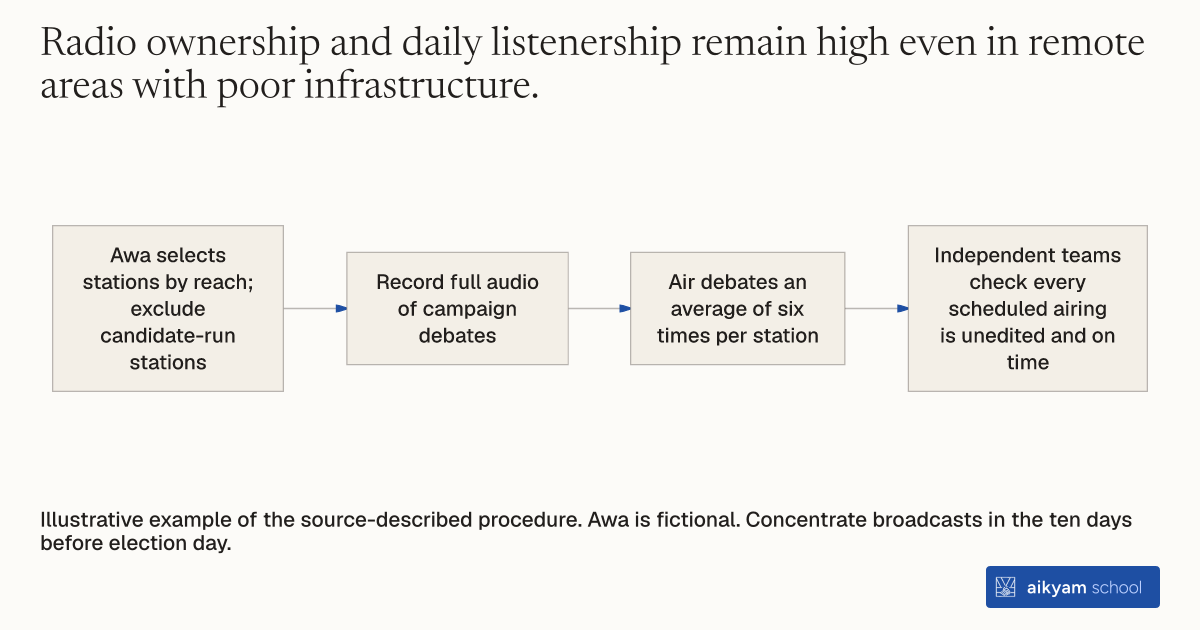
- Awa selects stations by reach; exclude candidate-run stations
- Record full audio of campaign debates
- Air debates an average of six times per station
- Independent teams check every scheduled airing is unedited and on time
Illustrative example of the source-described procedure. Awa is fictional. Concentrate broadcasts in the ten days before election day.
See source →How
When to use
In developing democracies with weak traditional media and poor road infrastructure, most voters cannot attend live political debates in person. Program managers need a broad distribution channel to disseminate verbatim policy promises across entire electoral districts without political bias. This approach broadcasts and rebroadcasts audio recordings of local candidate debates through independent community radio stations.
Rebroadcast recorded candidate debates through non-partisan community radio stations to maximize constituent exposure to policy promises.
- Select partnering community radio stations based on signal strength to maximize population coverage while excluding stations owned or managed by candidates.
- Record full audio of local candidate debates held during the campaign period.
- Broadcast and rebroadcast recorded debates an average of six times per station, concentrating transmissions in the ten days before election day.
- Hire independent monitoring teams to tune into every scheduled transmission to confirm debates air unedited and on schedule.
Why it works
Airing unedited recordings repeatedly ensures broad constituent exposure to standardized candidate policy platforms while preventing partisan station managers from editing or misrepresenting debate content.
Example
Internews partnered with 43 non-partisan community radio stations across Liberia during the 2017 legislative election to rebroadcast 129 electoral district debates. Independent monitors from youth organization Naymote verified scheduled transmissions, reaching an estimated 90 percent of the national population.
About the study
Participants
73 electoral districts, 43 partnering radio stations, 129 debates, and a panel survey of 4,060 voters across Liberia in 2017.
Study Design
District-level field experiment evaluating radio debate rebroadcasting (comparing standard versus intensive 10-rebroadcast schedules) and tracking listener exposure via independent radio monitors and voter panel surveys.
Results
Rebroadcasting achieved an estimated 90 percent population coverage across Liberia; citizen debate listening index increased by 0.304 standard deviations in high candidate participation districts, but increasing scheduled broadcasts from 2 to 10 produced no additional statistically significant gain in exposure index (-0.021 standard deviations in intensive invitation districts).