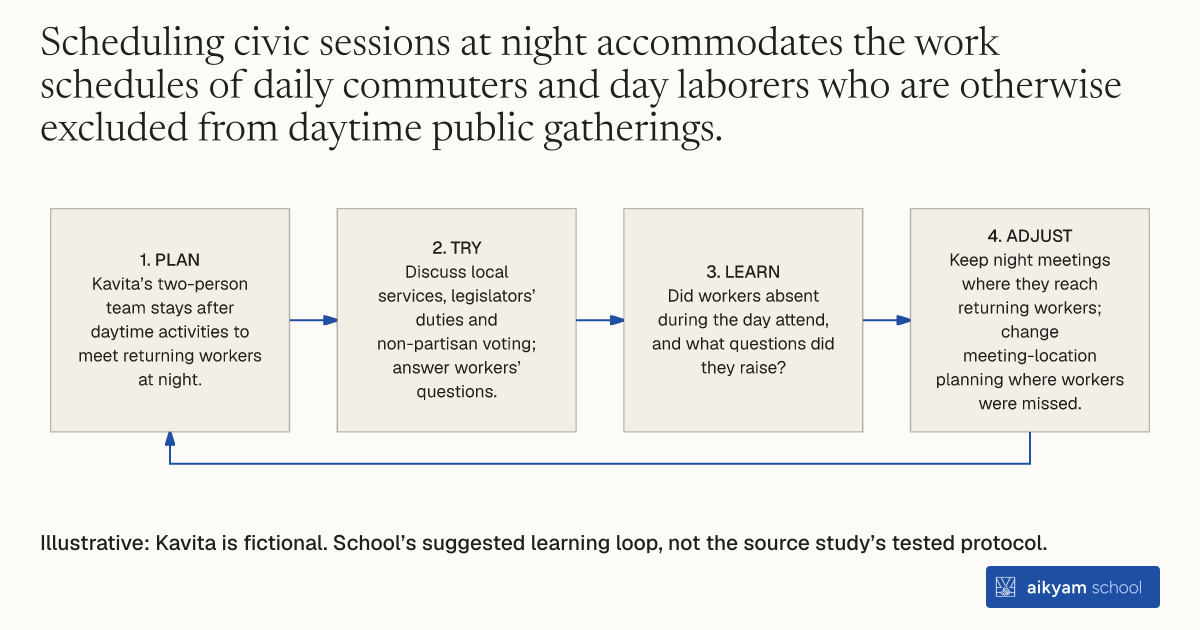
Try, learn and adjust
Check returning workers receive the campaign message
- Plan: Kavita’s two-person team stays after daytime activities to meet returning workers at night.
- Try: Discuss local services, legislators’ duties and non-partisan voting; answer workers’ questions.
- Learn: Did workers absent during the day attend, and what questions did they raise?
- Adjust: Keep night meetings where they reach returning workers; change meeting-location planning where workers were missed.
Illustrative: Kavita is fictional. School’s suggested learning loop, not the source study’s tested protocol.
See source →School’s suggested learning loop, not a tested source procedure. Observe attendance by returning workers and their questions; the study evaluated the full campaign.
How
When to use
In rural communities, many working-age adults commute daily to distant agricultural fields or urban centers, missing daytime civic events, door-to-door visits, and street theater. Night meetings address this participation gap by gathering returning day laborers in late evening sessions. This ensures that commuter workers receive non-partisan campaign messages about development priorities and candidate quality before election day.
Conduct late-night community meetings in targeted villages to deliver non-partisan voter education messages to residents who commute for work during the day.
- Deploy a two-person NGO field team to remain in the village through the late evening following daytime campaign activities.
- Identify gathering spots where agricultural laborers and out-of-village daily workers return after work.
- Assemble returning workers for a late-night session focused on civic engagement and non-partisan voting principles.
- Review the core campaign message that elected legislators are accountable for local infrastructure and public service delivery.
- Discuss local development priorities and answer questions from workers who were absent during daytime meetings and street performances.
Why it works
Direct evening outreach ensures that wage earners participate in non-partisan voter mobilization and consider local candidate quality.
Example
NGO campaign staff from Sarathi conducted night meetings across treated villages in 36 polling-station clusters in central Uttar Pradesh during the 2007 state assembly election. These night sessions helped ensure broad village coverage, contributing to a campaign that achieved an overall 9 percentage point increase in voter turnout (11 percentage points for male voters) and reduced support for criminal caste-preferred candidates.
About the study
Participants
The trial evaluated 36 polling-station clusters across Lalitpur, Bahraich, and Sitapur districts in rural Uttar Pradesh, India, surveying 1,538 Hindu voters.
Study Design
Researchers evaluated night meetings as the final evening component of a randomized cluster field experiment where campaign teams executed a structured one-day campaign schedule, evaluating outcomes through official Election Commission returns and post-election surveys.
Results
Night meetings contributed to full-village coverage for an intervention that increased male voter turnout by 11 percentage points (raising turnout from 60% to roughly 67%), increased overall voter turnout by 9 percentage points, and reduced lower-caste voting for caste-preferred parties from 57.6% to 47.6%.