Try, learn and adjust
Check understanding after soil fertility videos
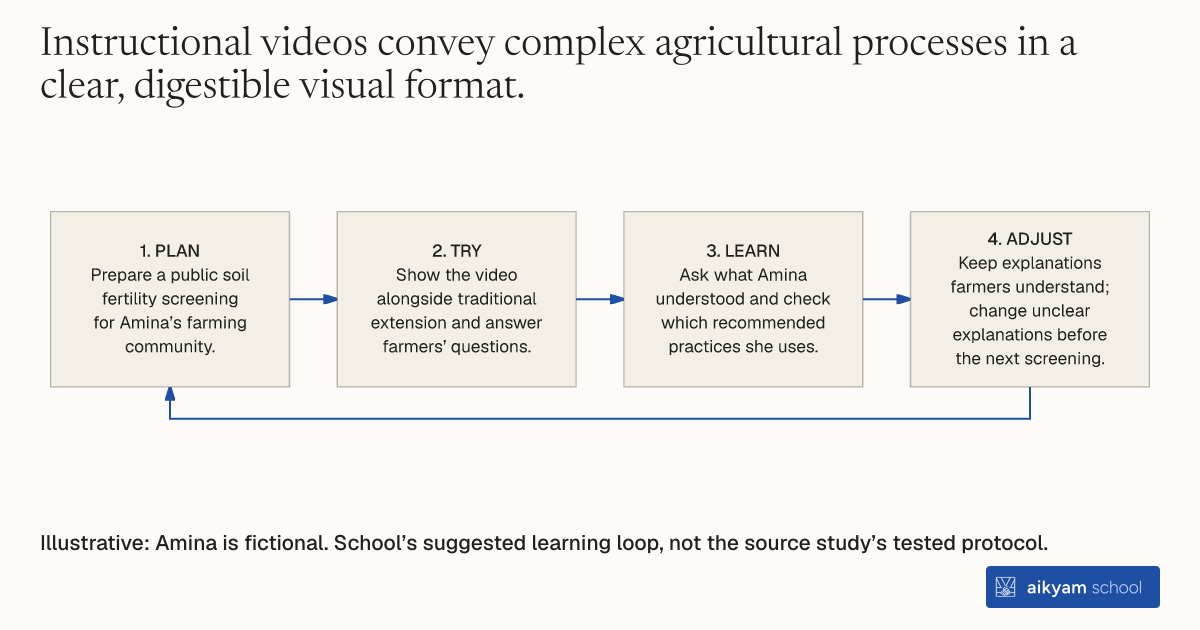
- Plan: Prepare a public soil fertility screening for Amina’s farming community.
- Try: Show the video alongside traditional extension and answer farmers’ questions.
- Learn: Ask what Amina understood and check which recommended practices she uses.
- Adjust: Keep explanations farmers understand; change unclear explanations before the next screening.
Illustrative: Amina is fictional. School’s suggested learning loop, not the source study’s tested protocol.
See source →Observe knowledge and use of recommended soil fertility practices. School suggests this learning loop; it was not tested by the source.
How
When to use
Traditional agricultural extension visits struggle to convey complex soil management techniques clearly to rural smallholders. Infrequent advisory visits leave farmers with limited understanding of integrated soil fertility practices. This method helps extension agencies use public video screenings to improve farmer technical knowledge and practice adoption.
Combine traditional extension services with public video screenings on integrated soil fertility management to train smallholder farmers.
- Extension managers produce instructional video modules demonstrating integrated soil fertility management techniques.
- Extension workers schedule public community video screening events in target rural villages.
- Extension officers project videos and host public screening events for local farming households.
- Extension agents lead interactive discussions after viewings to answer farmer questions.
- Smallholder farmers adopt recommended soil fertility management practices on their fields.
Why it works
Combining video screenings with traditional extension reinforces learning and makes technical advice easier to comprehend and apply.
Example
In Ethiopia, combining traditional extension with public video screenings on integrated soil fertility management improved farmer knowledge by 15 percent and adoption of recommended practices by 38 percent relative to farmers receiving no extension services.
About the study
Participants
Smallholder farming households in rural Ethiopia.
Study Design
Randomized evaluation testing traditional extension combined with public video screenings against a control group receiving no extension services.
Results
Combining traditional extension with public video screenings improved farmer knowledge by 15 percent and adoption of recommended practices by 38 percent relative to farmers receiving no extension services.