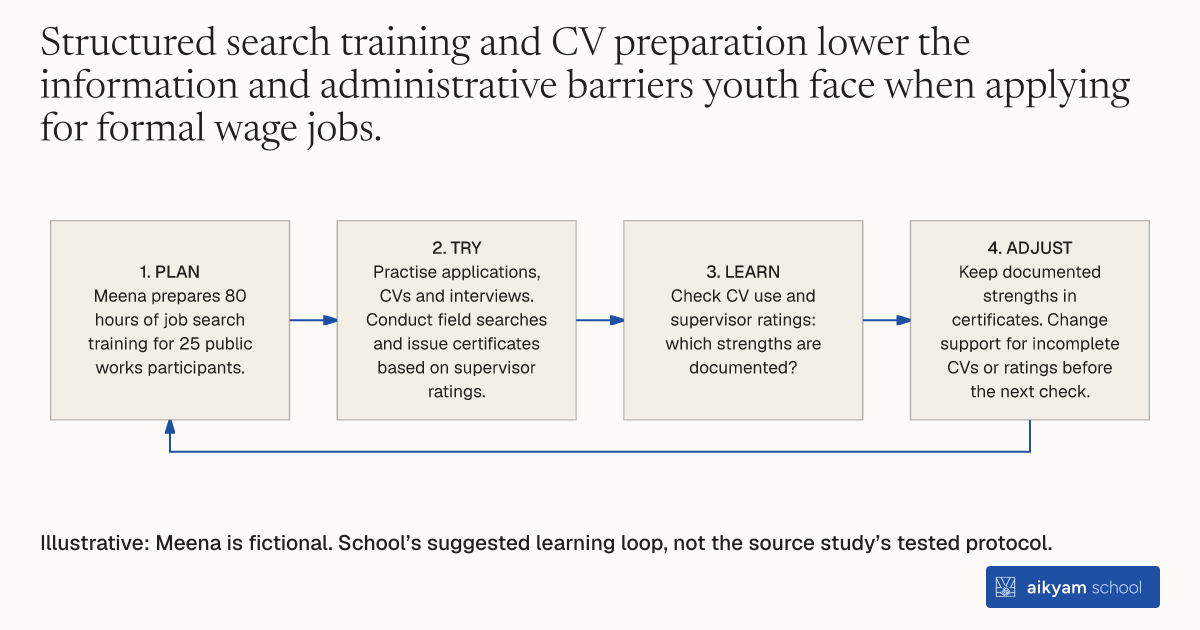
Try, learn and adjust
Check job search practice and certification
- Plan: Meena prepares 80 hours of job search training for 25 public works participants.
- Try: Practise applications, CVs and interviews. Conduct field searches and issue certificates based on supervisor ratings.
- Learn: Check CV use and supervisor ratings: which strengths are documented?
- Adjust: Keep documented strengths in certificates. Change support for incomplete CVs or ratings before the next check.
Illustrative: Meena is fictional. School’s suggested learning loop, not the source study’s tested protocol.
See source →Observe CV use and competency ratings. School suggests this learning loop; job placement and total earnings gains were not statistically established against public works alone.
How
When to use
Underemployed urban youth participating in temporary public works programs often struggle to transition into formal wage jobs due to limited job search knowledge, poor application materials, and lack of verified credentials. Providing job search skills instruction and performance certification helps low-skilled workers identify formal wage opportunities and signal skills to potential employers. This method serves young public works beneficiaries seeking stable wage employment following workfare completion.
Deliver an 80-hour wage job search training curriculum and supervisory evaluation system to public works beneficiaries in cohorts of 25 workers during the final month of public employment.
- Form public works participants into 25-person brigades and schedule 80 hours of instruction across two two-week classroom periods.
- Teach job search techniques, CV preparation, application methods, and job interview strategies adapted for low-skilled youth.
- Assign participants afternoon field exercises to identify local wage job opportunities, visit potential employers, and contact professional networks.
- Train brigade supervisors on team management and worker feedback to replicate formal workplace environments.
- Rate participants periodically on core workplace competencies and issue official work certificates specifying individually demonstrated strengths.
Why it works
Objective supervisory ratings provide job seekers with credible credentials that signal workplace competence to formal employers.
Example
In Côte d'Ivoire, 1,000 public works participants across 40 brigades received 80 hours of job search skills training and work certification during their final month of workfare. Job search knowledge improved by 0.26 standard deviations, and CV usage during job search increased by 10 percentage points from a control baseline of 15 percent. However, this did not produce statistically significant increases in post-program wage job placement or total monthly earnings compared to public works alone.
About the study
Participants
4,160 urban youth aged 18 to 30 years across 16 localities in Côte d'Ivoire, with 1,000 beneficiaries assigned to the public works plus wage job search training arm.
Study Design
Randomized controlled trial using a two-stage design: individual lottery selection into public works followed by brigade-level randomization into complementary training arms, evaluated 12 to 15 months post-program.
Results
Job search skills knowledge increased by 0.26 standard deviations, and CV usage for job search increased by 10 percentage points from a control baseline of 15 percent. Post-program wage employment rate and total monthly earnings showed no statistically significant differences compared to public works alone.