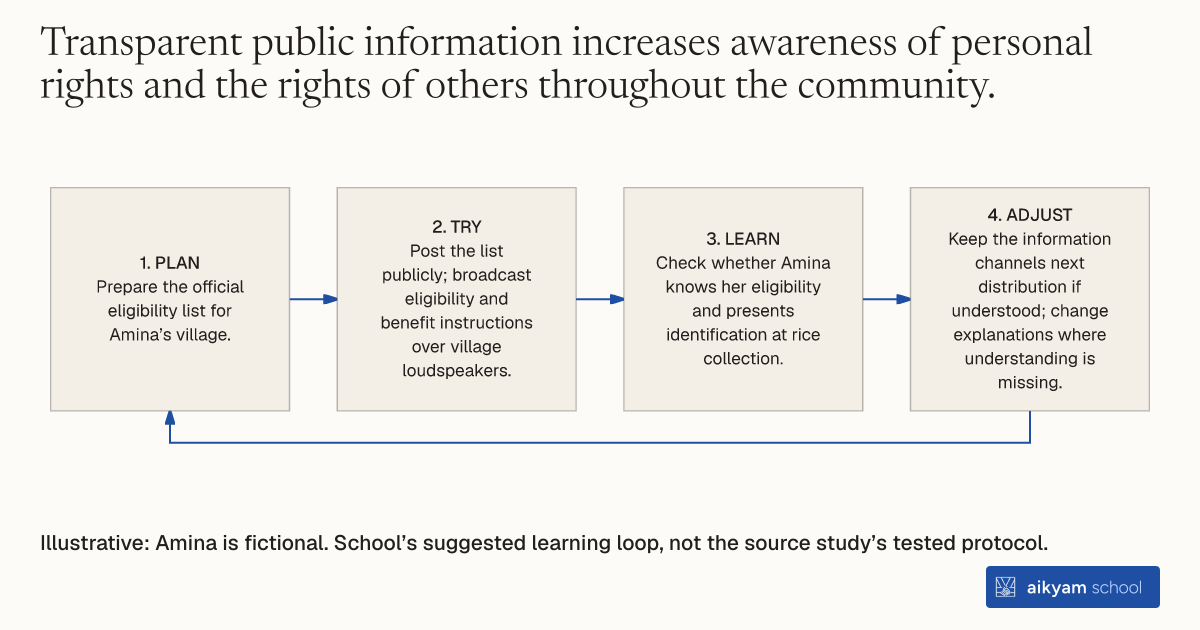
Try, learn and adjust
Check public access to benefit information
- Plan: Prepare the official eligibility list for Amina’s village.
- Try: Post the list publicly; broadcast eligibility and benefit instructions over village loudspeakers.
- Learn: Check whether Amina knows her eligibility and presents identification at rice collection.
- Adjust: Keep the information channels next distribution if understood; change explanations where understanding is missing.
Illustrative: Amina is fictional. School’s suggested learning loop, not the source study’s tested protocol.
See source →School’s suggested learning loop: Observe awareness, identification receipt and presentation. This loop does not estimate the added effect of public information.
How
When to use
Social assistance programs often suffer when local leaders hide eligibility rules or control distribution privately. Beneficiaries may not know if they qualify or feel empowered to claim their benefits. Post official recipient lists in public spaces and broadcast program details over village loudspeakers for all community members to hear.
Publicize program eligibility lists and benefit details community-wide to make citizen rights common knowledge.
- Compile the official government list of households eligible for subsidized assistance.
- Post the full eligibility lists in public gathering areas throughout the village.
- Broadcast eligibility criteria and benefit card instructions over the village loudspeaker system.
- Encourage targeted beneficiaries to present their identification cards at distribution points.
- Enable community members to verify eligibility status and hold local distribution officials accountable.
Why it works
This shared knowledge strengthens citizen bargaining power and equips beneficiaries to demand their full entitlement.
Example
In Indonesia, adding public eligibility posters and loudspeaker announcements in card-receiving villages doubled the total benefit increase for low-income households, yielding a 34 percent benefit increase worth Rp 9,666 per month relative to comparison villages.
About the study
Participants
192 villages in Indonesia assigned to public information sub-treatments across three provinces, targeting low-income households in the Raskin subsidized rice program.
Study Design
Randomized controlled trial comparing villages receiving identification cards alongside public posters and loudspeaker broadcasts against villages receiving cards only and comparison villages without cards over an eighteen-month study.
Results
Publicizing information doubled the additional benefits received relative to card-only groups, increasing total benefits by 34 percent over the comparison group (a gain of Rp 9,666 or US$0.99 per month), while making households 19 percent more likely to receive their card and 50 percent more likely to present it when picking up rice.