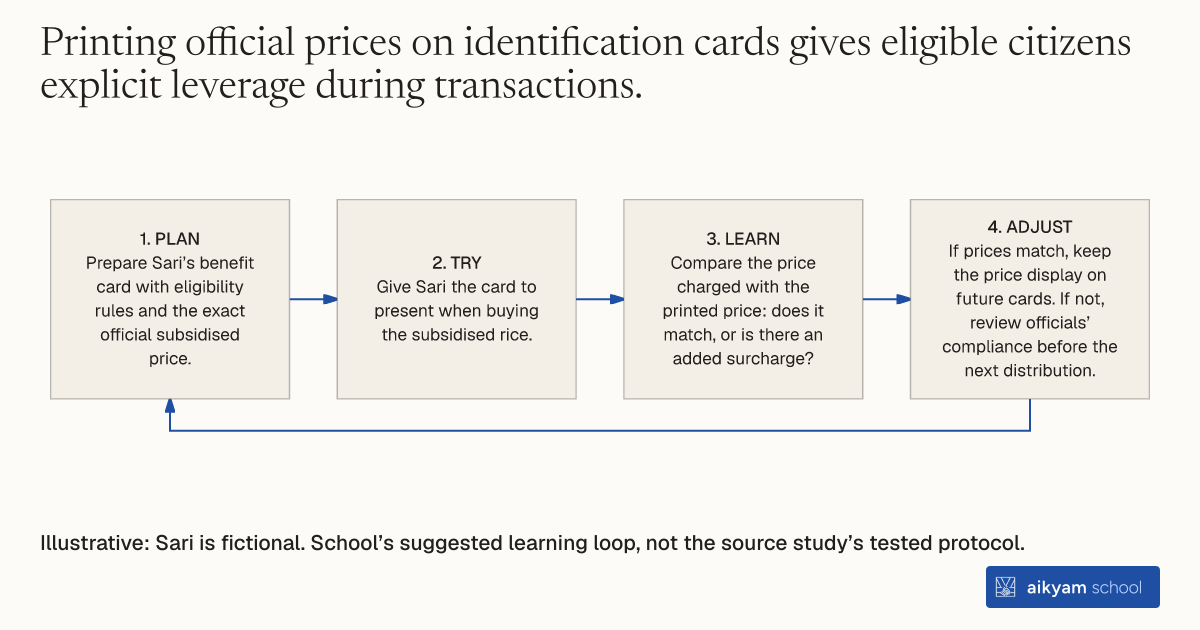
Try, learn and adjust
Check whether the printed benefit price is honoured
- Plan: Prepare Sari’s benefit card with eligibility rules and the exact official subsidised price.
- Try: Give Sari the card to present when buying the subsidised rice.
- Learn: Compare the price charged with the printed price: does it match, or is there an added surcharge?
- Adjust: If prices match, keep the price display on future cards. If not, review officials’ compliance before the next distribution.
Illustrative: Sari is fictional. School’s suggested learning loop, not the source study’s tested protocol.
See source →Observe the printed official price, the price charged and any added surcharge. Do not assume a benefit increase.
How
When to use
Local officials often inflate copayment prices or alter terms when administering subsidized benefit programs. Beneficiaries without explicit price information cannot verify official rates or resist overcharging. Print official subsidized prices directly on benefit identification cards for eligible low-income households.
Print official copayment prices directly on social assistance identification cards to strengthen beneficiary bargaining power against official markup.
- Determine the official subsidized price for program commodities or services.
- Design identification cards that prominently display both eligibility rules and the exact subsidized purchase price.
- Mail or distribute the price-inclusive cards directly to eligible low-income households.
- Instruct cardholders to present the card during purchase transactions to verify official rates.
- Require local distribution officials to honor the printed official price without added surcharges.
Why it works
This improved bargaining power prevents local officials from overcharging or withholding entitlements.
Example
In Indonesia, adding the official subsidized price to Raskin rice identification cards nearly doubled card impacts, yielding an extra 24 percent increase in total benefits worth Rp 6,802 per month relative to comparison villages.
About the study
Participants
187 villages in Indonesia receiving basic-plus-price cards out of 572 total study villages across three provinces, targeting Raskin-eligible households.
Study Design
Randomized controlled trial comparing villages receiving cards with printed subsidized price information against villages receiving basic cards without prices and comparison villages receiving no cards over an eighteen-month period.
Results
Cards with price information increased total monthly benefits received by 24 percent relative to comparison villages (a gain of Rp 6,802 or US$0.69 per month), which was 113 percent higher than gains from basic cards without price information.