Research description
Describe campaign hierarchy
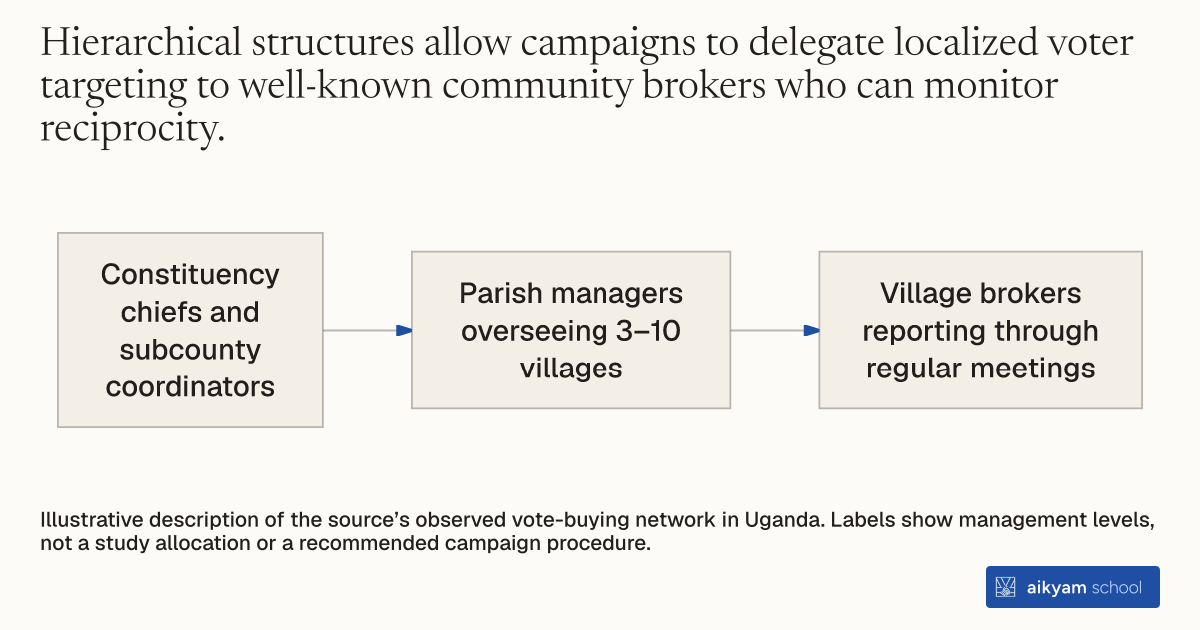
- Constituency chiefs and subcounty coordinators
- Parish managers overseeing 3–10 villages
- Village brokers reporting through regular meetings
Illustrative description of the source’s observed vote-buying network in Uganda. Labels show management levels, not a study allocation or a recommended campaign procedure.
See source →How
When to use
In competitive elections where vote buying is widespread, candidates cannot personally identify or distribute gifts to thousands of voters. Political campaigns need structured management layers to supervise localized gift distribution, identify receptive voters, and track voter mobilization. Organizing a multi-tiered hierarchy of campaign staff and local brokers enables politicians to conduct vote buying across entire electoral districts.
Manage vote-buying operations through a multi-tiered hierarchy of constituency chiefs, subcounty coordinators, parish managers, and village brokers.
- Appoint constituency chiefs to lead political campaign strategy and oversee financial resources across an entire constituency.
- Recruit subcounty coordinators to direct campaign operations across subcounties.
- Assign parish managers to supervise campaign activities and oversee operations across three to ten villages.
- Hire village-level brokers who are well-known community figures to identify reciprocity-minded voters and hand out cash or goods like soap, sugar, or salt.
- Hold regular meetings between parish managers and village brokers to coordinate mobilization efforts.
- Assess electoral outcomes in each broker's area of work after elections to monitor performance and maintain accountability up the hierarchy.
Why it works
Managing brokers through parish and subcounty leaders ensures operational accountability up the chain of command.
Example
During Uganda's 2016 general election, incumbent candidates deployed pyramidal campaign networks across constituencies, hiring 45% more managers, 67% more coordinators, and 73% more chiefs than challenger candidates to direct vote buying.
About the study
Participants
438 political brokers surveyed across 11 districts and 62 parishes, along with 28,454 registered voters across 918 parishes in Uganda.
Study Design
Systematic post-election broker survey (57% incumbent brokers, 43% challenger brokers) combined with a two-level randomized saturation design evaluating election operations across 1,603 polling stations.
Results
All surveyed Members of Parliament reported using brokers in 2016; 73% of brokers were confident gift recipients voted as instructed, 30% transported voters to polls, and 28% cast ballots on behalf of recipients.