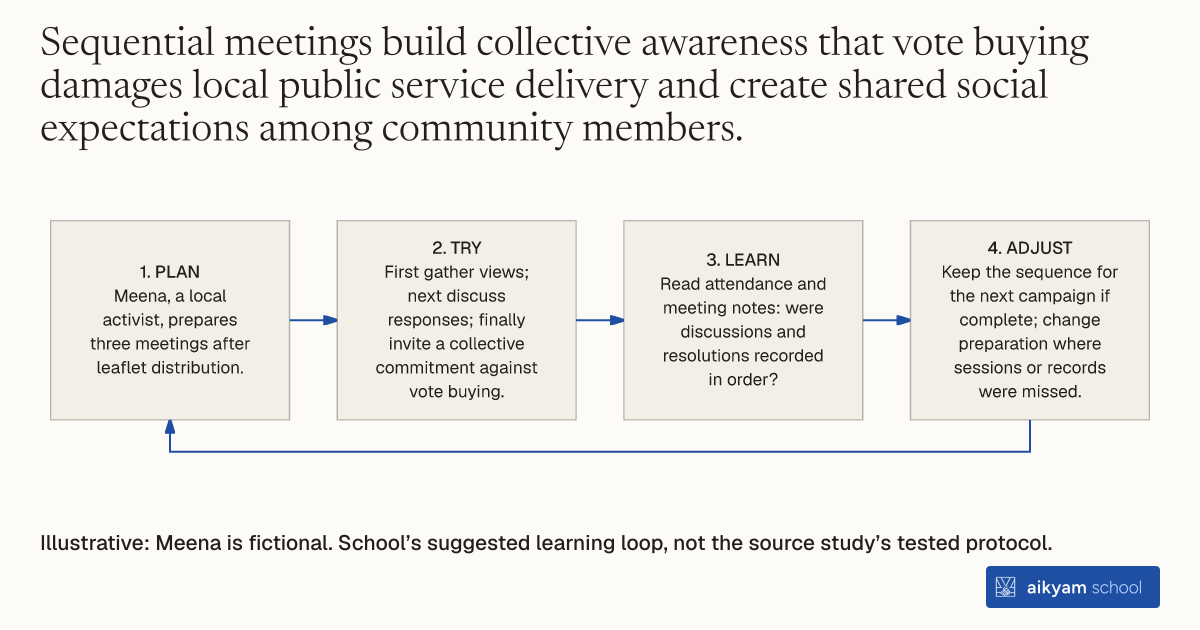
Try, learn and adjust
Check the sequence of village deliberation
- Plan: Meena, a local activist, prepares three meetings after leaflet distribution.
- Try: First gather views; next discuss responses; finally invite a collective commitment against vote buying.
- Learn: Read attendance and meeting notes: were discussions and resolutions recorded in order?
- Adjust: Keep the sequence for the next campaign if complete; change preparation where sessions or records were missed.
Illustrative: Meena is fictional. School’s suggested learning loop, not the source study’s tested protocol.
See source →School’s suggested learning loop: Observe participation, discussion notes and resolutions. This loop does not isolate meeting effects from the wider campaign.
How
When to use
In electoral settings where vote buying is widespread, individual voters often feel powerless to refuse gifts or demand political accountability on their own. Community members need structured opportunities to discuss the shared social costs of vote selling and deliberate on collective responses. Organizing sequential village-level meetings enables citizens to move from initial awareness to group discussion and community commitments.
Organize three sequential village community meetings led by local activists during the three weeks preceding an election to foster collective deliberation against vote buying.
- Recruit and train local civil society activists who reside in or are well known within the targeted villages.
- Hold the first meeting to introduce the anti-vote-buying campaign, review distributed educational materials, and gather citizens' views on vote buying.
- Hold the second meeting as a transition session to facilitate structured collective deliberation on how to tackle vote buying in the village.
- Hold the third meeting to invite community members to collectively commit to refusing gift offers in exchange for votes.
- Record meeting attendance and document participant discussions and resolutions using standardized field scripts and notes.
Why it works
This collective discussion increases perceived social sanctions for vote selling and empowers citizens to break gift-reciprocity norms.
Example
In the three weeks before Uganda's 2016 general election, civil society activists held three-stage meetings across 1,427 targeted villages, reaching an estimated 62,566 participating households with an average of 30 participants per meeting.
About the study
Participants
28,454 registered voters surveyed across 918 parishes in 53 districts in Uganda, covering 1.2 million registered voters.
Study Design
Two-level randomized saturation design at parish and polling station levels, evaluated using post-election voter surveys, key informant interviews, and official election results.
Results
Participation in community meetings increased citizen expectations of social sanctions for vote selling by 2.6 percentage points and increased awareness of the negative consequences of vote buying by 1.3 percentage points.