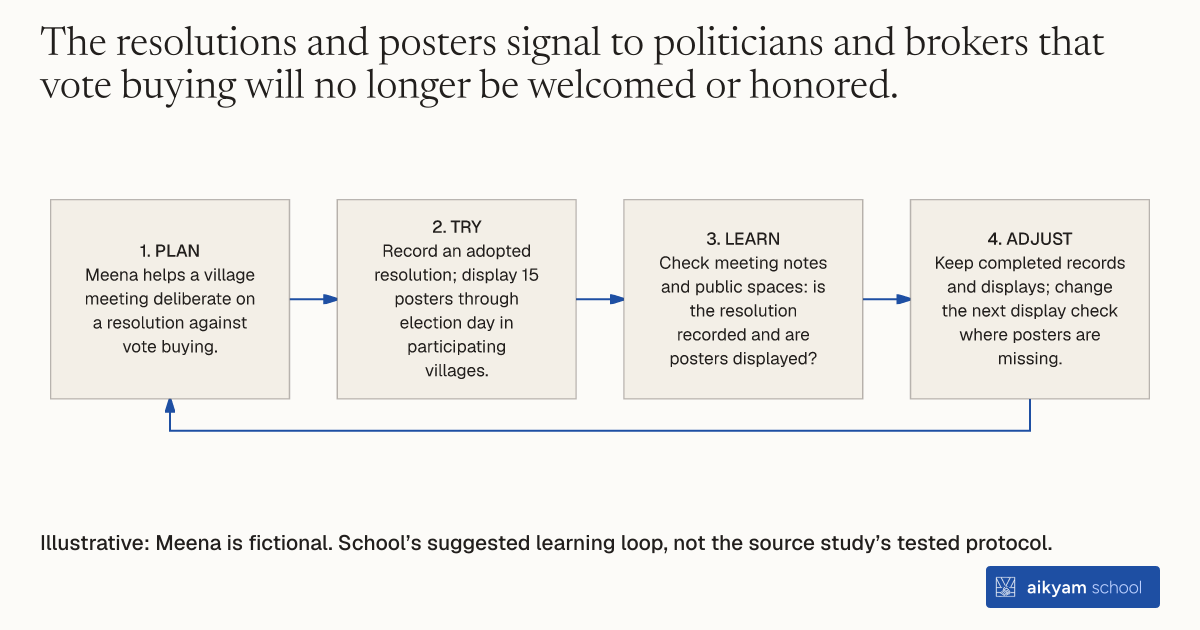
Try, learn and adjust
Check resolutions and poster display
- Plan: Meena helps a village meeting deliberate on a resolution against vote buying.
- Try: Record an adopted resolution; display 15 posters through election day in participating villages.
- Learn: Check meeting notes and public spaces: is the resolution recorded and are posters displayed?
- Adjust: Keep completed records and displays; change the next display check where posters are missing.
Illustrative: Meena is fictional. School’s suggested learning loop, not the source study’s tested protocol.
See source →School’s suggested learning loop: Observe adopted resolutions and poster display. This loop does not establish changes in vote selling.
How
When to use
In elections where vote buying is widespread, individual commitments against selling votes are difficult to sustain without visible local consensus. Community members need public commitments and visual markers that signal to fellow villagers and visiting politicians that vote selling is discouraged. Facilitating village-wide resolutions and displaying campaign posters creates a public signal of local coordination against vote buying.
Facilitate community meetings to adopt village-level resolutions against vote buying and display posters declaring the village a no-vote-buying zone.
- Hold a community deliberation meeting led by civil society activists in each targeted village before the election.
- Invite meeting participants to deliberate on and adopt a village resolution against vote buying.
- Document the adopted resolution in activist meeting notes.
- Place 15 prominent posters throughout each participating village declaring the location a no-vote-buying village.
- Keep posters displayed in public spaces through election day to remind voters and signal politicians that gifts will not guarantee votes.
Why it works
This coordination increases perceived social sanctions among community members for selling votes.
Example
In the three weeks before Uganda's 2016 general election, civil society activists facilitated resolution deliberations across 1,427 targeted villages and posted 21,390 posters across treatment villages.
About the study
Participants
28,454 registered voters surveyed across 918 parishes in 53 districts in Uganda, covering 1.2 million registered voters.
Study Design
Two-level randomized saturation design at parish and polling station levels, evaluated using post-election voter surveys, key informant interviews, and official election results.
Results
Awareness of village resolutions increased by 8.2 percentage points in treated villages (5.6 percentage points for "eat widely, vote wisely" resolutions and 2.6 percentage points for "no vote buying" resolutions), while expectations of social sanctions for vote selling increased by 2.6 percentage points.