Try, learn and adjust
Check consistent fabric grading
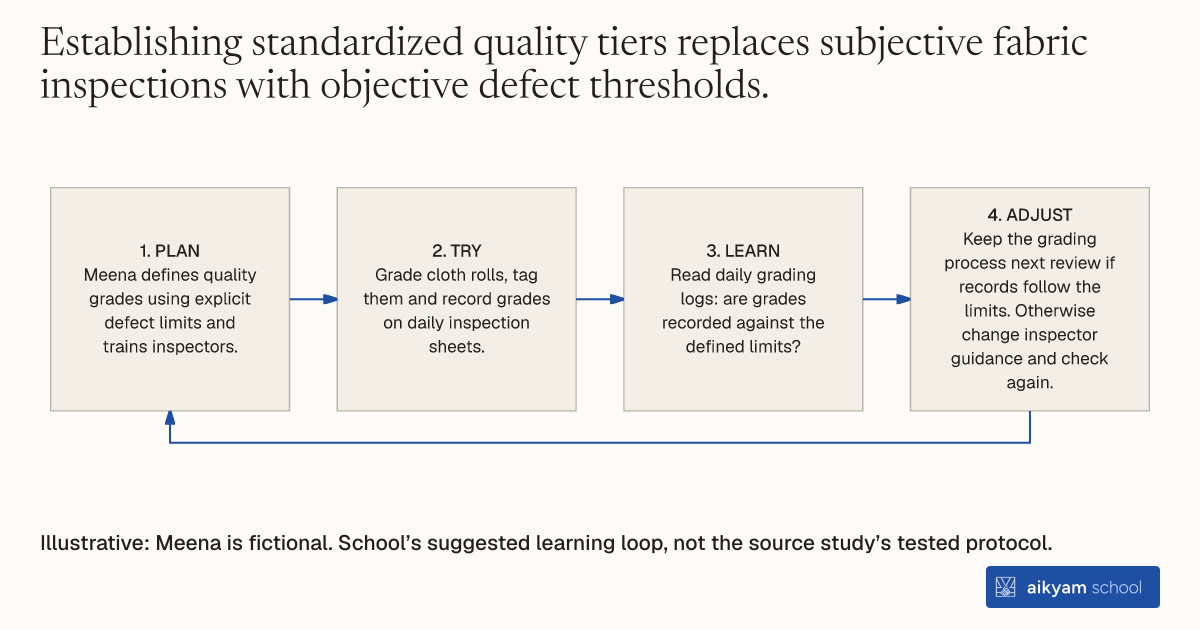
- Plan: Meena defines quality grades using explicit defect limits and trains inspectors.
- Try: Grade cloth rolls, tag them and record grades on daily inspection sheets.
- Learn: Read daily grading logs: are grades recorded against the defined limits?
- Adjust: Keep the grading process next review if records follow the limits. Otherwise change inspector guidance and check again.
Illustrative: Meena is fictional. School’s suggested learning loop, not the source study’s tested protocol.
See source →Observe roll tags, defect limits and grading logs. School suggests this learning loop; it is not the source’s tested procedure.
How
When to use
Manufacturing plants often inspect output without clear, standardized criteria for categorizing product quality grades. A standardized fabric gradation system classifies finished goods based on explicit defect thresholds. This helps factory managers and sales teams accurately price products, minimize customer disputes, and enforce consistent quality standards on the shop floor.
Implement a standardized fabric gradation and classification protocol to evaluate finished woven goods against defined defect thresholds.
- Define explicit quality criteria and defect count limits for grading fabric into standard quality tiers.
- Train quality inspectors and floor checkers to evaluate finished cloth rolls using defined gradation criteria.
- Mark assigned fabric quality grades on physical roll tags and log results on daily inspection sheets.
- Quality supervisors review daily gradation logs during management meetings to track quality trends across weaving lines.
- Sales staff use standardized quality grades to set product prices and resolve buyer quality complaints.
Why it works
Clear classification ensures fair market pricing and provides reliable operational feedback to shop-floor production teams.
Example
In 2008, consultants introduced standardized fabric gradation systems across experimental textile plants near Mumbai, India. Having a fabric gradation system grew from 55% adoption in 2008 to 85% in 2011 and reached 100% in 2017, with zero adopting plants dropping the system over nine years.
About the study
Participants
28 manufacturing plants across 17 family-owned cotton weaving firms near Mumbai, India, averaging 270 employees, $8.5 million in assets, and $7.5 million in annual sales.
Study Design
Randomized Controlled Trial (RCT) tracking 38 management practices across treatment and control plants from 2008 to 2017.
Results
Adoption of a fabric gradation system grew from 55% pre-intervention to 85% in 2011 and reached 100% in 2017 with a 0% drop rate, while well-defined gradation systems were maintained in 45% of plants in 2017.