Try, learn and adjust
Check debate timing and radio rebroadcasts
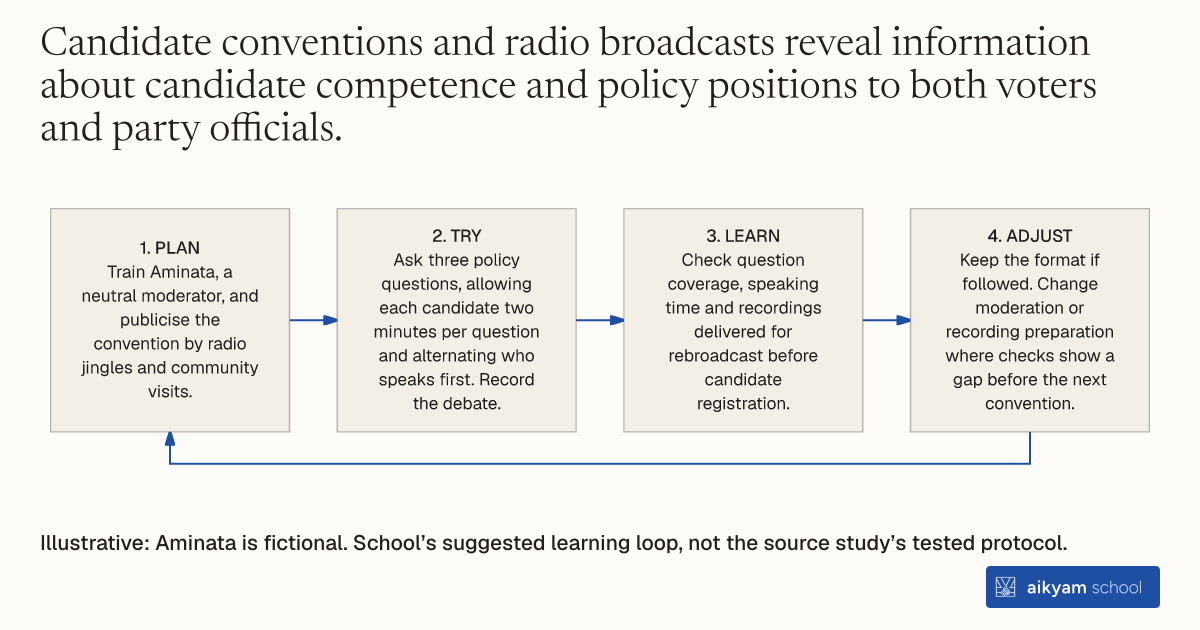
- Plan: Train Aminata, a neutral moderator, and publicise the convention by radio jingles and community visits.
- Try: Ask three policy questions, allowing each candidate two minutes per question and alternating who speaks first. Record the debate.
- Learn: Check question coverage, speaking time and recordings delivered for rebroadcast before candidate registration.
- Adjust: Keep the format if followed. Change moderation or recording preparation where checks show a gap before the next convention.
Illustrative: Aminata is fictional. School’s suggested learning loop, not the source study’s tested protocol.
See source →School’s suggested, untested loop. Observe speaking arrangements, recordings and repeated broadcasts over subsequent days; do not infer nomination effects.
How
When to use
Political parties in developing countries often rely on central party elites to appoint candidate representatives without voter input. This creates information gaps regarding candidate qualifications and public preferences. Holding public candidate conventions broadcast over local radio enables citizens and party officials to evaluate candidate quality and policy positions transparently before nominations.
Organise constituency candidate debates and broadcast recordings over local radio to inform voters and party officials prior to candidate nominations.
- Partner civil society organizations train neutral moderators to host public town-hall candidate debates with party officials, members, and local residents.
- Publicize upcoming debate events to local voters using radio jingles and targeted community visits.
- Pose three standard policy questions to candidates, allowing each candidate two minutes per question while alternating who speaks first.
- Ask candidates how they will manage constituency facilitation funds and handle local issues like power supply and mining royalties.
- Record the audio of the live candidate debate gathering.
- Deliver audio recordings to local radio stations to rebroadcast the event multiple times over subsequent days before official candidate registration.
Why it works
This shared information helps voters learn about candidate qualifications while allowing party leaders to identify better performing candidates.
Example
Search for Common Ground and two major political parties hosted public candidate debates in 23 treated constituencies in Sierra Leone for the 2018 Parliamentary elections. Candidates received 2 minutes to respond to each debate question, and 18 percent of surveyed local voters attended a town hall or listened to a radio broadcast.
About the study
Participants
92 party-races across 80 Parliamentary constituencies in Sierra Leone, encompassing 390 candidate aspirants and 7,544 surveyed registered voters, 43 percent of whom had no formal schooling and an average of 4.86 years of education.
Study Design
A randomized controlled trial that randomly assigned 23 treatment and 23 control constituencies independently for two major political parties, gathering pre- and post-convention survey data from voters, candidates, and party leaders.
Results
Unprompted voter ability to name candidates increased by 11.6 percentage points from a control baseline of 46.9 percent to 58.5 percent in treatment areas. Parties increased the selection of voters' first-choice candidates from 37.8 percent in control races to 60.7 percent in treatment races, representing a 22.96 percentage point increase.