Research procedure
Recruit ambassadors through random selection
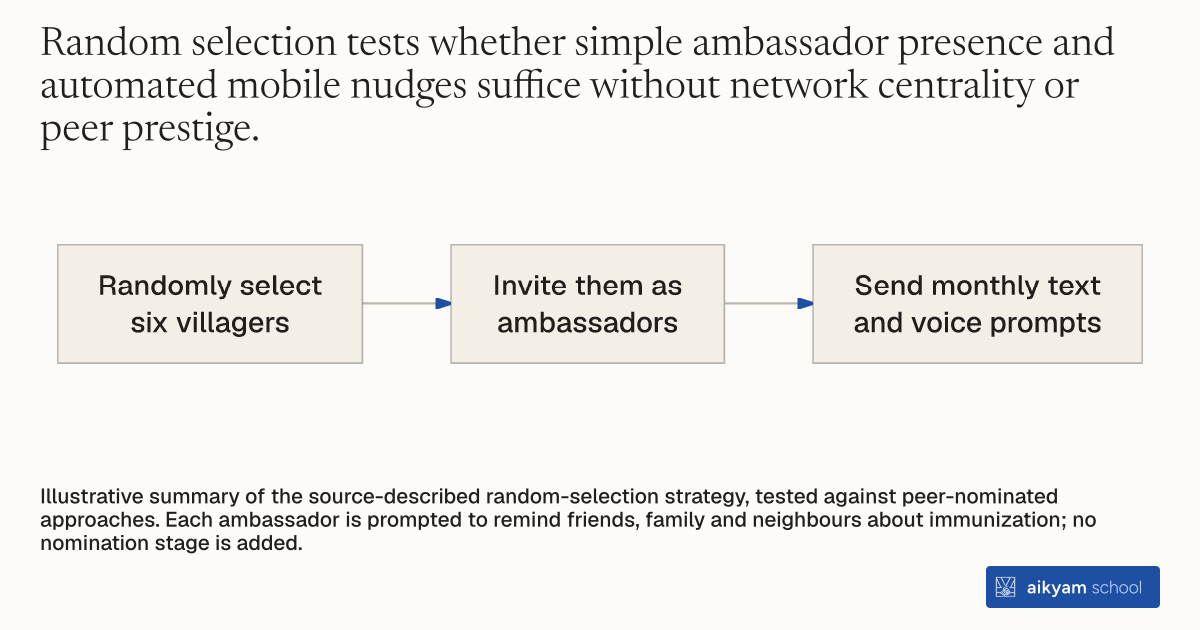
- Randomly select six villagers
- Invite them as ambassadors
- Send monthly text and voice prompts
Illustrative summary of the source-described random-selection strategy, tested against peer-nominated approaches. Each ambassador is prompted to remind friends, family and neighbours about immunization; no nomination stage is added.
See source →How
When to use
Health programs often try to activate local community members as informal messengers to encourage child vaccinations. Program managers may be tempted to recruit participants at random rather than conducting targeted network mapping. Deploy this method as a baseline benchmarking strategy to evaluate whether randomly chosen community ambassadors can effectively drive health behavior change.
Select six community members entirely at random in each village to act as local immunization ambassadors.
- Program coordinators obtain or construct village roster lists of community residents.
- Program coordinators randomly select six individuals in each target village without network mapping or peer surveys.
- Program managers invite the six randomly chosen individuals to serve as local health ambassadors.
- System operators send automated monthly mobile communications consisting of one text message and one voice call to each randomly selected ambassador.
- Ambassadors receive prompts asking them to remind friends, family, and neighbors to take their children for monthly immunizations.
Why it works
However, individuals chosen without regard to social network position or community reputation spread information far less effectively than peer-nominated information hubs.
Example
In a subset of 912 villages in Haryana, India, researchers assigned villages to a random selection arm where six community ambassadors were chosen randomly to evaluate against peer-nominated ambassador strategies.
About the study
Participants
Caregivers and children across a subset of 912 villages in 140 primary health centers and 755 subcenters in Haryana, India.
Study Design
A randomized controlled trial evaluating randomly selected ambassadors against community-nominated information hubs, trusted individuals, trusted information hubs, and comparison villages.
Results
Six randomly selected ambassadors were tested across villages as a control strategy for ambassador targeting, proving less effective at driving full immunization than community-nominated information hubs.