Research steps
Survey households to a community quota
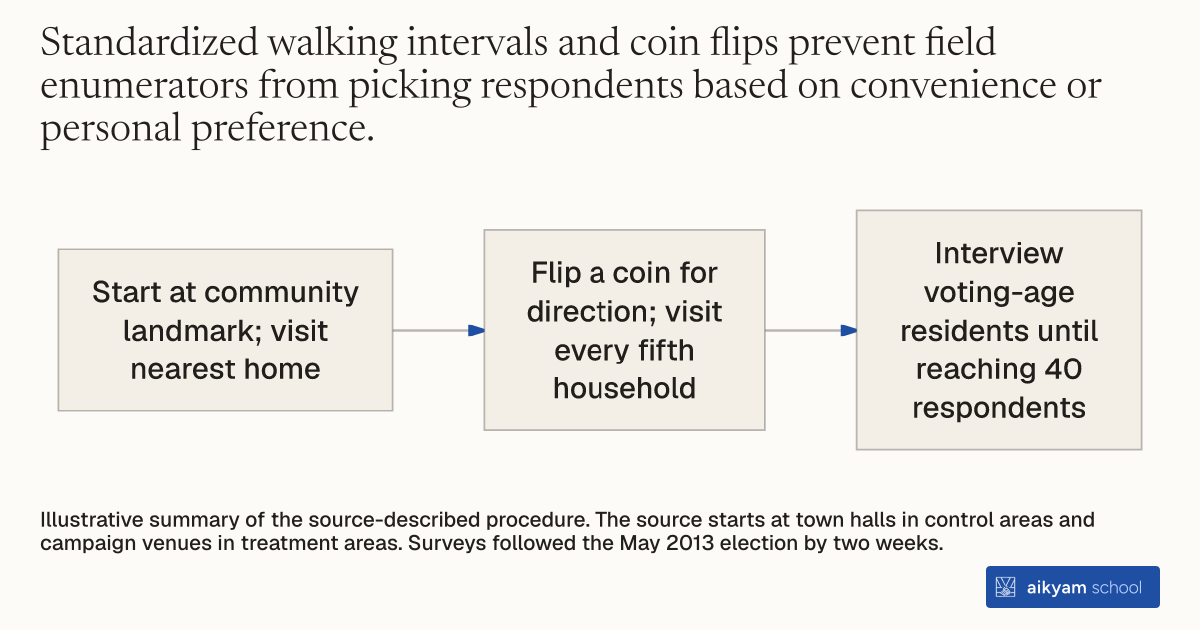
- Start at community landmark; visit nearest home
- Flip a coin for direction; visit every fifth household
- Interview voting-age residents until reaching 40 respondents
Illustrative summary of the source-described procedure. The source starts at town halls in control areas and campaign venues in treatment areas. Surveys followed the May 2013 election by two weeks.
See source →How
When to use
Researchers need to evaluate individual political attitudes, demographics, and self-reported voting behavior after an electoral campaign. Official election results provide aggregated precinct totals without individual background details. Conducting household surveys with quota targets gives evaluators granular individual data across local communities.
Collect individual survey data across target communities by conducting a structured random walk sampling procedure up to a fixed respondent quota.
- Station enumerators at a central landmark in each community, using local town halls in control areas and campaign meeting venues in treatment areas.
- Select the household nearest to the starting landmark as the first survey location.
- Flip a coin to determine the initial walking direction along the street or path.
- Walk along the selected path and visit every fifth household to interview voting-age residents.
- Repeat the selection procedure until completing the target quota of 40 respondents per community.
Why it works
Establishing quota targets ensures consistent sample sizes across all study locations.
Example
Two weeks after the May 2013 election in the Philippines, the Center for Popular Empowerment deployed enumerators across treatment and control barangays in Metro Manila and Calabarzon. Enumerators started at local town halls or meeting locations, flipped coins for direction, and interviewed every fifth household until reaching 40 respondents per barangay. This generated a post-election survey sample of 1,314 voting-age citizens, yielding 1,082 effective responses with valid turnout data.
About the study
Participants
1,314 voting-age citizens (1,082 effective survey respondents) across treatment and control barangays in Metro Manila and Calabarzon, Philippines.
Study Design
Post-election individual survey using random walk sampling from central landmarks to every fifth household with a quota target of 40 respondents per barangay.
Results
Survey data revealed that deliberative town halls increased individual voting probability by 13.48 percentage points overall and increased female voting probability by 24 percentage points for Akbayan.