Research groups
Randomise the designated transfer recipient
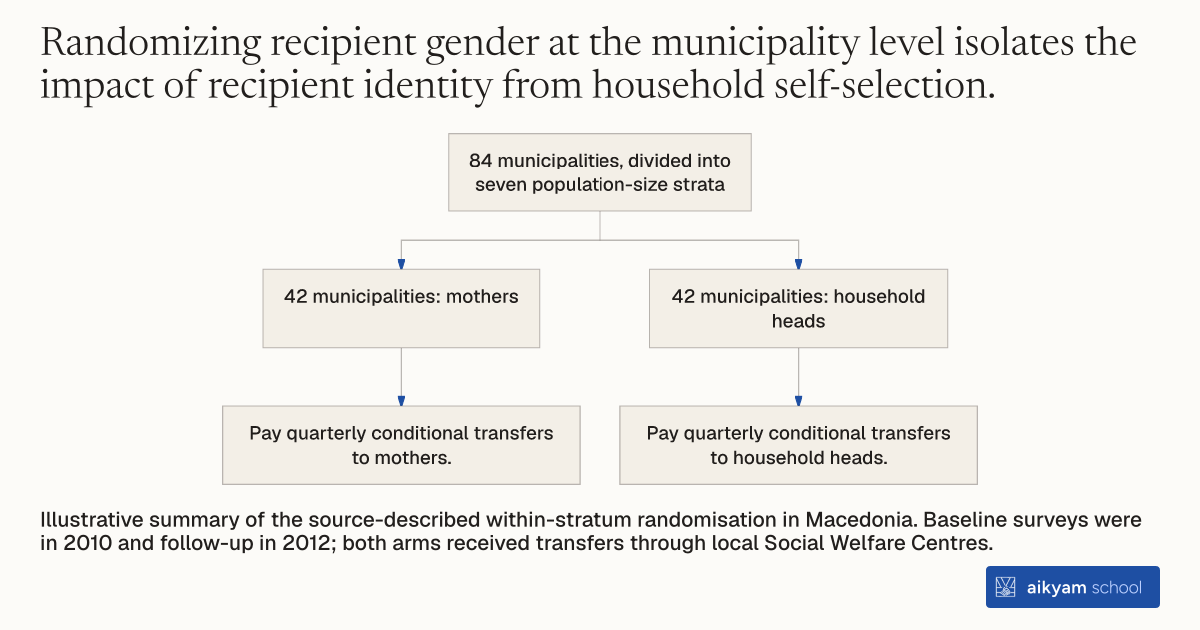
84 municipalities, divided into seven population-size strata
- 42 municipalities: mothers
- Pay quarterly conditional transfers to mothers.
- 42 municipalities: household heads
- Pay quarterly conditional transfers to household heads.
Illustrative summary of the source-described within-stratum randomisation in Macedonia. Baseline surveys were in 2010 and follow-up in 2012; both arms received transfers through local Social Welfare Centres.
See source →How
When to use
Social welfare programs often assign cash transfers to mothers under the assumption that women spend money differently than men. Evaluating whether gender targeting actually alters household spending requires comparing households where mothers receive transfers against households where fathers receive transfers. Randomizing transfer recipient gender across geographic areas provides direct experimental evidence on intra-household resource control.
Randomize the designated recipient gender of conditional cash transfers across stratified geographic municipalities.
- Divide all 84 municipalities into 7 strata based on population size.
- Randomize municipalities within each stratum into two equal groups of 42.
- Assign 42 municipalities to designate mothers as cash transfer recipients.
- Assign 42 municipalities to designate household heads as cash transfer recipients.
- Disburse quarterly conditional cash transfer payments through local Social Welfare Centres according to municipality assignment.
Why it works
Stratifying by population size ensures that both treatment groups share similar demographic and economic characteristics before transfers begin.
Example
The Ministry of Labour and Social Policy in Macedonia divided 84 municipalities into 7 strata by population size in 2010. Program administrators randomized 42 municipalities to pay transfers to mothers and 42 municipalities to pay transfers to household heads. Evaluation surveys tracked 1053 households across both groups over two years.
About the study
Participants
1053 households with children aged 14 to 18 sampled at baseline across 84 municipalities in Macedonia, with 830 households followed up after two years. Households averaged 4.5 members and 55 percent were Muslim.
Study Design
A randomized trial across all 84 municipalities in Macedonia, stratified by population size into 42 mother-recipient municipalities and 42 household-head-recipient municipalities. Surveys collected baseline data in 2010 and follow-up data in 2012.
Results
Assigning transfers to mothers increased the food budget share by 3.73 percentage points in OLS estimates with demographic controls, or 4 to 5 percent in structural demand system models. Distributions of food budget shares shifted significantly to the right in mother-recipient municipalities at follow-up.