Research procedure
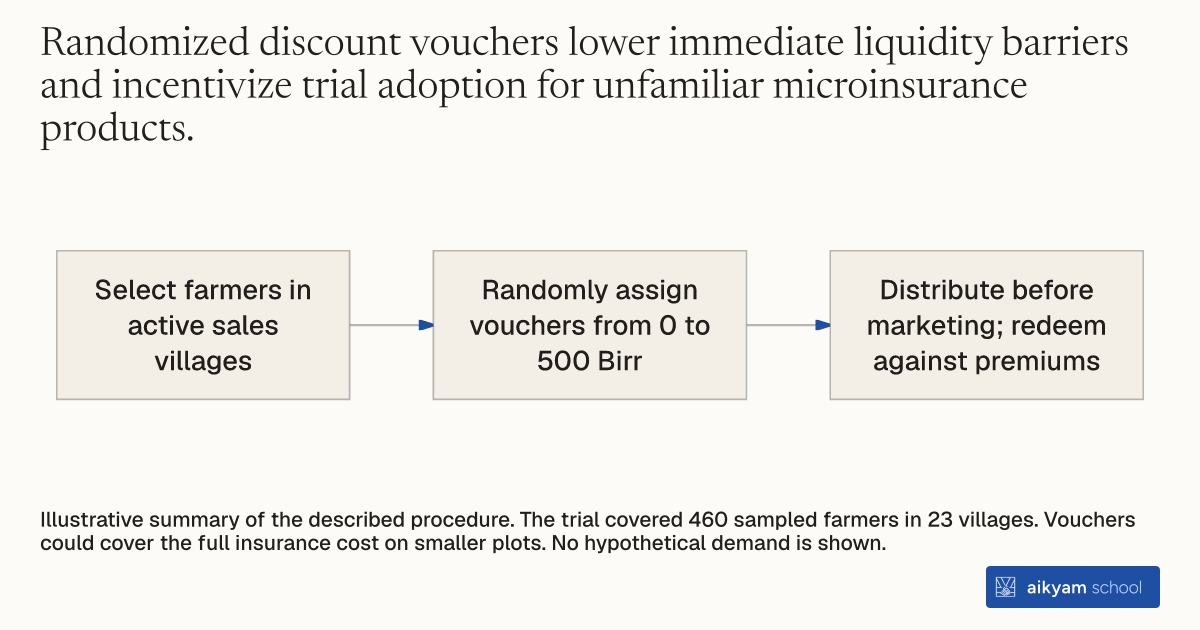
Randomise insurance discount vouchers
- Select farmers in active sales villages
- Randomly assign vouchers from 0 to 500 Birr
- Distribute before marketing; redeem against premiums
Illustrative summary of the described procedure. The trial covered 460 sampled farmers in 23 villages. Vouchers could cover the full insurance cost on smaller plots. No hypothetical demand is shown.
See source →How
When to use
Smallholder farmers in drought-vulnerable regions refuse commercial weather index insurance at market prices due to liquidity constraints and unfamiliarity with novel financial products. Insurance providers face zero commercial adoption during initial market rollouts. Distribute randomized price discount vouchers to farmers before sales campaigns to induce trial purchase and observe real price elasticity.
Distribute individual randomized price discount vouchers to targeted smallholders prior to marketing weather index insurance policies.
- Select sampled smallholders in active rural cooperative sales villages.
- Assign individual voucher face values randomly between 0 and 500 Birr.
- Distribute discount vouchers to participants before insurance marketing teams arrive.
- Redeem voucher credits directly against weather index insurance premiums during purchase transactions.
- Permit farmers to apply voucher values toward covering full insurance costs on smaller land plots.
Why it works
Voucher availability creates an active demonstration effect that allows research teams to observe true price elasticity without relying on hypothetical survey questions.
Example
In Amhara, Ethiopia, researchers randomly distributed discount vouchers ranging from 0 to 500 Birr to 460 sampled cooperative farmers across 23 active sales villages. Receiving a voucher increased insurance purchase probability from 0% among unsubsidized subjects to 38.0% overall, with 183 study households purchasing contracts.
About the study
Participants
N = 460 rural smallholder households across 23 primary cooperative villages in Amhara, Ethiopia.
Study Design
Field randomized control trial assigning individual voucher values (0 to 500 Birr) evaluated via probit regressions with village clustering and kebele-fixed effects.
Results
Receiving a voucher increased actual insurance purchase probability by 34.4% to 38.0% (p < 0.01), with a voucher amount marginal effect of 0.392 to 0.421 (p < 0.05). Unsubsidized study uptake was 0%, and only 21% of buyers paid personal cash beyond the voucher face value.