Research design
Compare cookstove price offers
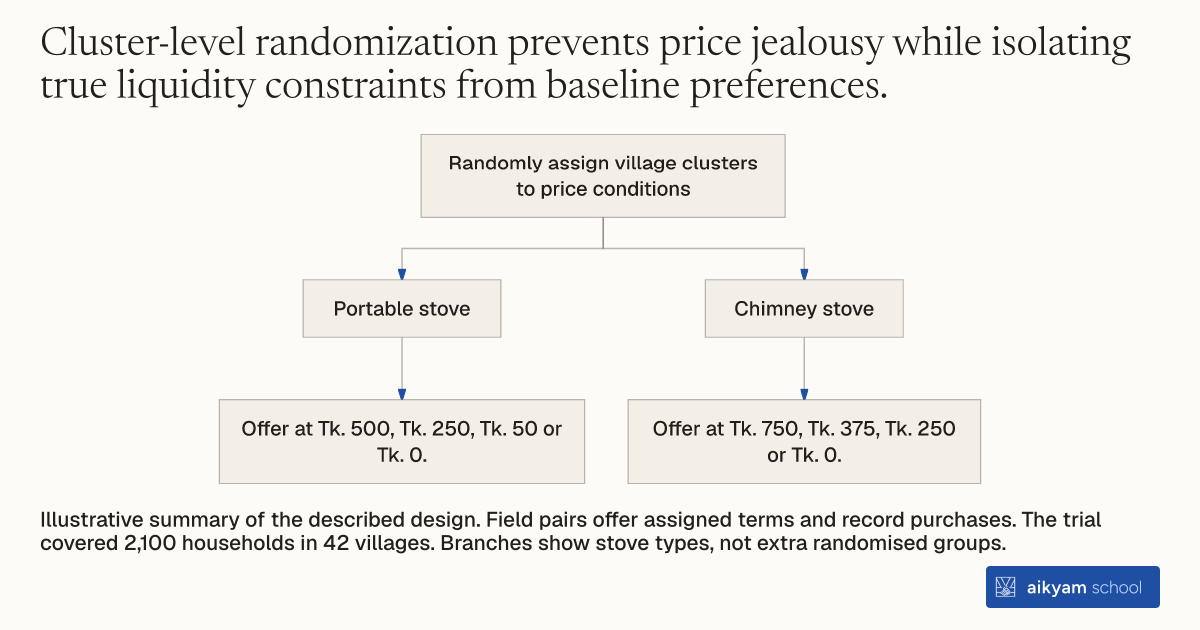
Randomly assign village clusters to price conditions
- Portable stove
- Offer at Tk. 500, Tk. 250, Tk. 50 or Tk. 0.
- Chimney stove
- Offer at Tk. 750, Tk. 375, Tk. 250 or Tk. 0.
Illustrative summary of the described design. Field pairs offer assigned terms and record purchases. The trial covered 2,100 households in 42 villages. Branches show stove types, not extra randomised groups.
See source →How
When to use
Low-income households in rural areas face significant liquidity constraints that block the adoption of new health-improving technologies. Offering standardized prices can obscure how price sensitivity varies across different product tiers and subsidy levels. This method evaluates price elasticity of demand across multiple technology options by randomizing price discounts across community clusters.
Test technology price elasticity by randomizing cluster-level price subsidies across multiple price points and product types.
- Assign rural village clusters to distinct price treatment arms at the cluster level to avoid local price spillovers.
- Market portable single-pot cookstoves at full price (Tk. 500), 50 percent subsidy (Tk. 250), heavy subsidy (Tk. 50), or free (Tk. 0).
- Market fixed chimney cookstoves at full price (Tk. 750), 50 percent subsidy (Tk. 375), heavy subsidy (Tk. 250), or free (Tk. 0).
- Deploy field enumerator pairs to offer assigned price terms during household visits across trial villages.
- Record adoption purchases and calculate marginal adoption response rates per subsidy tier across stove designs.
Why it works
Testing multiple price points reveals non-linear demand drops when moving from free distribution to low co-payments.
Example
Researchers in 42 villages in Jamalpur Sadar and Hatia, Bangladesh offered portable stoves at Tk. 500, Tk. 250, Tk. 50, or free, and chimney stoves at Tk. 750, Tk. 375, Tk. 250, or free to 2,100 households.
About the study
Participants
2,100 households across 42 rural villages in Jamalpur Sadar and Hatia upazilas, Bangladesh.
Study Design
Cluster-randomized trial offering portable and chimney cookstoves at full price, 50% subsidy, heavy subsidy, or free across village-level experimental arms.
Results
A 50% subsidy increased portable stove adoption by 12 percentage points and chimney stove adoption by 5 percentage points. Moving from free to heavily subsidized prices decreased portable stove adoption by 7 percentage points and chimney stove adoption by 34 percentage points.