Research procedure
Randomize service prices using vouchers
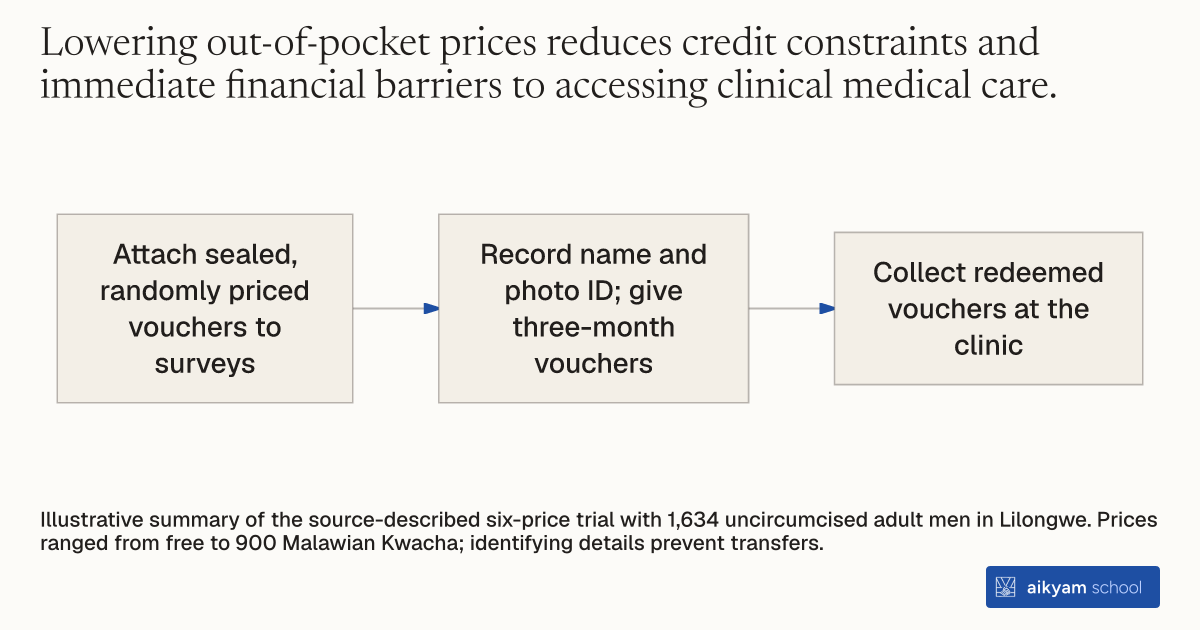
- Attach sealed, randomly priced vouchers to surveys
- Record name and photo ID; give three-month vouchers
- Collect redeemed vouchers at the clinic
Illustrative summary of the source-described six-price trial with 1,634 uncircumcised adult men in Lilongwe. Prices ranged from free to 900 Malawian Kwacha; identifying details prevent transfers.
See source →How
When to use
High upfront costs prevent low-income individuals from utilizing preventive health services. Fixed market fees create financial barriers even when perceived benefits exist. This method uses randomly distributed subsidized vouchers to test price sensitivity and increase service access among target adult men.
Distribute randomly priced fee-reduction vouchers to eligible individuals immediately following a household survey.
- Staple vouchers with randomly assigned discount amounts into sealed envelopes attached to baseline survey questionnaires.
- Record the respondent name and official photo identification type on the voucher to prevent voucher transfers.
- Offer vouchers valid for a three-month validity period redeemable at a local partner health clinic.
- Set randomized price levels ranging from a full subsidy to small discounts requiring payment up to 900 Malawian Kwacha.
- Collect redeemed vouchers at clinic intake when clients present for services to measure price-specific demand.
Why it works
Randomizing voucher values allows researchers to isolate the true causal effect of price on service adoption without confounding background demand.
Example
Researchers distributed vouchers with prices ranging from free to 900 Malawian Kwacha to 1,634 uncircumcised adult men in Lilongwe, Malawi. Offering free circumcisions increased take-up by 3.1 percentage points compared to the 900 Kwacha price, where zero men received circumcisions.
About the study
Participants
1,634 uncircumcised men aged 18 to 35 residing in urban Lilongwe, Malawi.
Study Design
Individual-level randomized trial offering clinic vouchers across six price points ranging from free to 900 Malawian Kwacha valid for three months.
Results
Overall clinic take-up was 2.63 percent; lowering the price from 900 Malawian Kwacha to free increased circumcision take-up by 3.1 percentage points and increased clinic interactions by 10.8 percentage points.