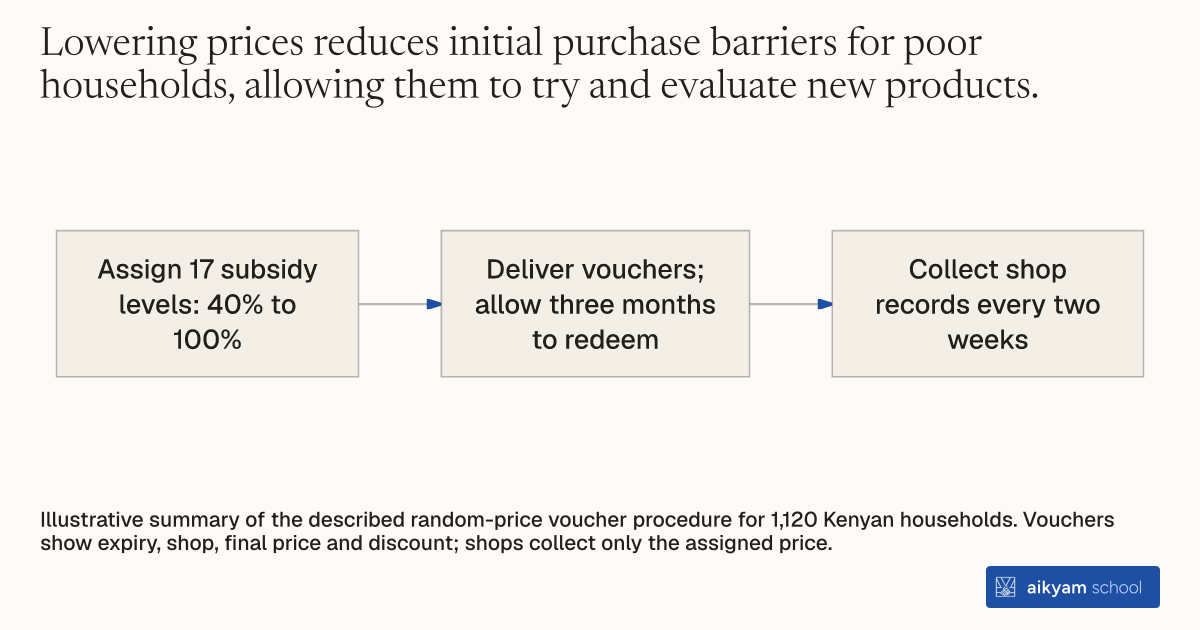
Research steps
Track randomised voucher prices
- Assign 17 subsidy levels: 40% to 100%
- Deliver vouchers; allow three months to redeem
- Collect shop records every two weeks
Illustrative summary of the described random-price voucher procedure for 1,120 Kenyan households. Vouchers show expiry, shop, final price and discount; shops collect only the assigned price.
See source →How
When to use
Essential health products often suffer from low adoption due to cash constraints and unknown product quality among rural families. Distributing randomized price discount vouchers helps health programs lower financial barriers and evaluate demand across price points. This approach gives households affordable access to health products while generating clear evidence on price sensitivity.
Issue randomized price discount vouchers to target households to subsidize access to new health goods through local retail outlets.
- Assign sampled households to one of 17 randomized subsidy levels ranging from 40 percent to 100 percent discount off the retail price.
- Visit households at home to hand over a personalized discount voucher showing the expiration date, redemption location, assigned final price, and discount amount.
- Set a three-month redemption window for household heads to bring their voucher to a designated local shop.
- Direct partner shops to collect voucher stubs and collect only the specified discounted price from the buyer.
- Collect redeemed vouchers and sales records from shops every two weeks to track redemptions across subsidy levels.
Why it works
Experiencing the product directly builds trust in its effectiveness without dampening future willingness to pay.
Example
In Busia District, Kenya, researchers distributed vouchers for Olyset bed nets to 1,120 households at randomized prices from 0 to 250 Kenyan shillings ($0 to $3.80); redemption reached 97.5 percent for free vouchers, 70 percent at 40 shillings, and dropped to 7 percent at 250 shillings.
About the study
Participants
1,120 rural households in Busia District, Western Kenya.
Study Design
Randomized controlled trial assigning 17 discount price levels across households with a 3-month voucher redemption window.
Results
Voucher redemption was 97.5 percent at zero price, 70 percent at 40 shillings ($0.60), 55 percent at 90 shillings ($1.40), around 30 percent at 100 shillings ($1.50), and 7 percent at 250 shillings ($3.80).