Research design
Randomly assign employment services
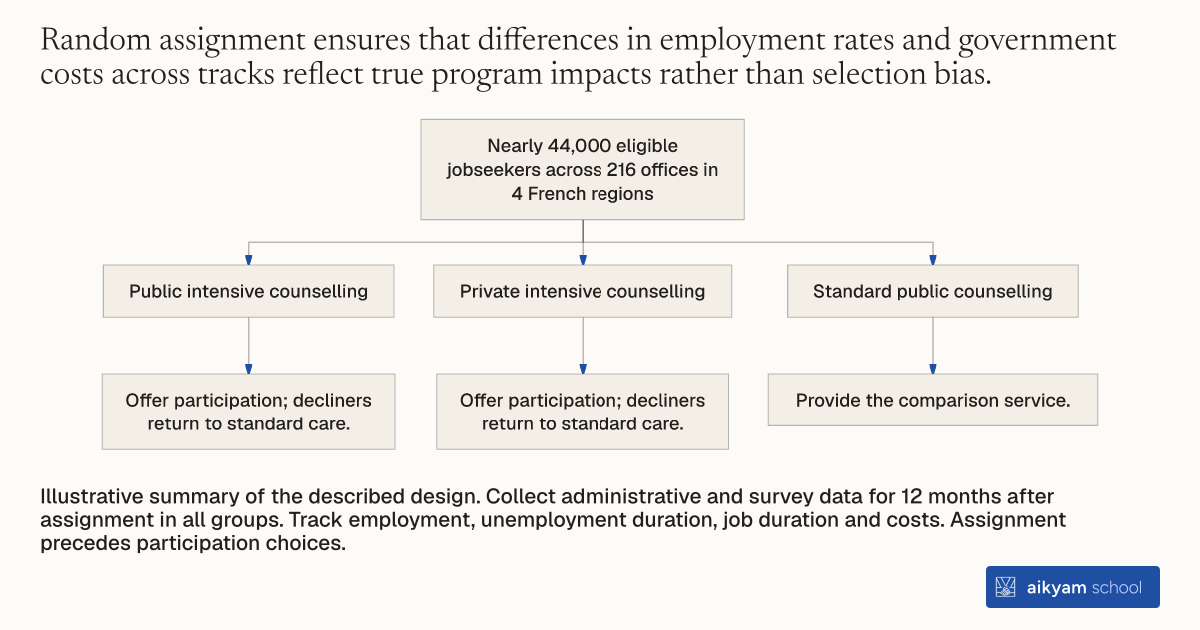
Nearly 44,000 eligible jobseekers across 216 offices in 4 French regions
- Public intensive counselling
- Offer participation; decliners return to standard care.
- Private intensive counselling
- Offer participation; decliners return to standard care.
- Standard public counselling
- Provide the comparison service.
Illustrative summary of the described design. Collect administrative and survey data for 12 months after assignment in all groups. Track employment, unemployment duration, job duration and costs. Assignment precedes participation choices.
See source →How
When to use
Governments and policymakers often lack empirical evidence comparing public and private social service delivery models. Assumptions about market efficiency or public capacity can lead to costly and suboptimal outsourcing decisions. A randomized evaluation tests public and private employment counseling models against standard care to measure real job placement impact and cost-effectiveness.
Evaluate employment counseling interventions by conducting a multi-region randomized controlled trial comparing public and private delivery tracks against standard public care.
- Select benefit-entitled job seekers entering unemployment across multiple administrative regions.
- Randomly assign eligible job seekers at the start of unemployment to public intensive counseling, private intensive counseling, or standard public comparison groups across local employment offices.
- Allow job seekers assigned to intensive intervention groups the option to enter or decline program participation, returning decliners to standard care.
- Collect administrative and survey data for twelve months post-assignment to track employment status, placement speed, job duration, and program expenditures across all experimental groups.
Why it works
Administrative and survey tracking provides objective data on placement speed, job durability, and fiscal return.
Example
ANPE and UNEDIC conducted a randomized evaluation from January to December 2007 across 216 public employment offices in four French administrative regions. Nearly 44,000 eligible job seekers were randomly assigned across public intensive, private intensive, and standard public comparison groups to track twelve-month outcomes.
About the study
Participants
Nearly 44,000 job seekers entering unemployment and entitled to at least one year of benefits across 216 local public employment offices in four French administrative regions.
Study Design
Randomized evaluation conducted from January to December 2007 assigning eligible job seekers to two intervention groups or a comparison group, with administrative and survey data collected over twelve months.
Results
The evaluation revealed that public intensive counseling increased exit rates to employment within six months by 50 percent (10.2 percentage points) compared to 22 percent (4.5 percentage points) for private counseling, while private counseling increased net government expenses by €1,162 per enrolled job seeker.