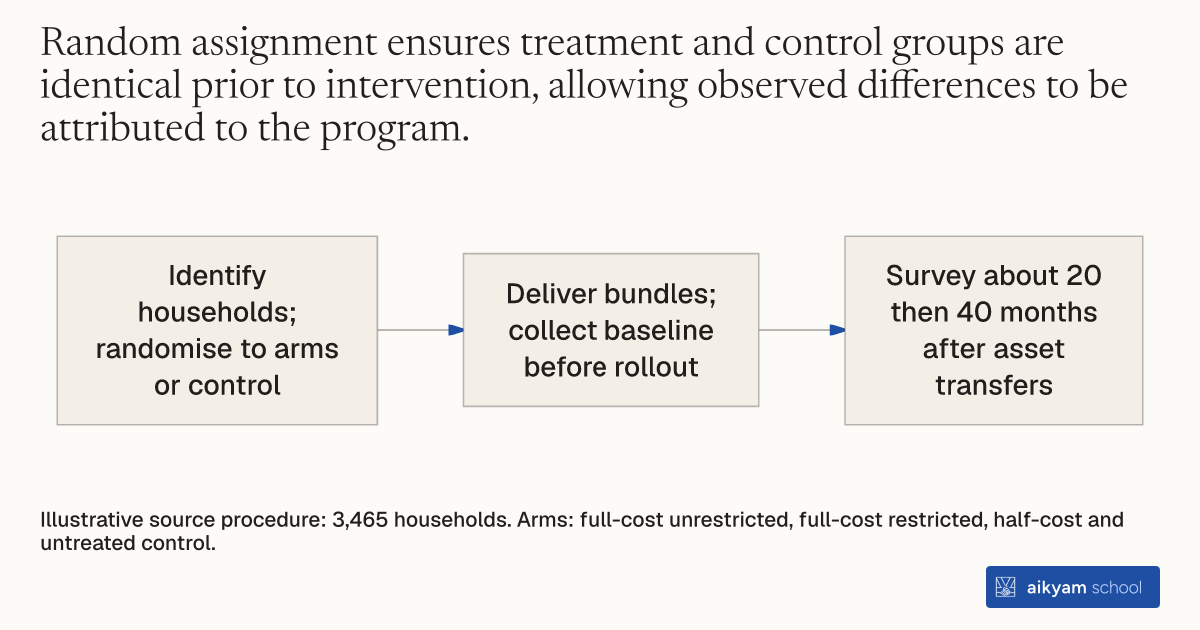
Research steps
Graduation trial
- Identify households; randomise to arms or control
- Deliver bundles; collect baseline before rollout
- Survey about 20 then 40 months after asset transfers
Illustrative source procedure: 3,465 households. Arms: full-cost unrestricted, full-cost restricted, half-cost and untreated control.
See source →How
When to use
Governments and development organisations need rigorous, causal evidence on multi-component poverty interventions. Evaluating graduation programs requires separating true impact from macroeconomic shocks or natural recovery. This methodology applies to researchers evaluating complex social protection programs for ultra-poor populations.
Conduct a multi-arm randomized controlled trial comparing varied program designs against an untreated control group across multiple follow-up rounds.
- Identify and target eligible ultra-poor households across rural villages in target governorates.
- Randomize target households into distinct treatment arms and an untreated control group.
- Deliver distinct intervention bundles, such as full-cost unrestricted, full-cost restricted, and half-cost variants, to assigned treatment arms.
- Collect baseline household data prior to intervention roll-out.
- Conduct a midline survey around 20 months after asset transfers to measure initial impacts across assets, income, employment, and food security.
- Conduct an endline survey around 40 months after asset transfers to evaluate the sustainability of impacts over time.
Why it works
Multi-arm designs allow evaluators to test specific programmatic parameters like cost levels and gender targeting rules.
Example
J-PAL MENA researchers evaluated the Bab Amal graduation program across 3,465 ultra-poor households in rural Assiut and Sohag governorates in Upper Egypt. The evaluation demonstrated sustained quadrupling of livestock value to EGP 12,580 versus EGP 3,350 in control and higher total monthly expenditure of EGP 4,509 versus EGP 4,272 in control at 40 months.
About the study
Participants
3,465 ultra-poor households in rural villages of Assiut and Sohag governorates, Upper Egypt.
Study Design
Randomized controlled trial comparing full-cost unrestricted, full-cost restricted, half-cost, and control groups across 20-month midline and 40-month endline follow-ups.
Results
Total livestock wealth reached EGP 12,580 in full-cost unrestricted and EGP 9,493 in half-cost at endline versus EGP 3,350 in control; total monthly expenditure reached EGP 4,509 in full-cost unrestricted and EGP 4,448 in half-cost at endline versus EGP 4,272 in control; female employment reached 21% at endline versus 13% in control.