Research steps
Measure responses to connectedness information
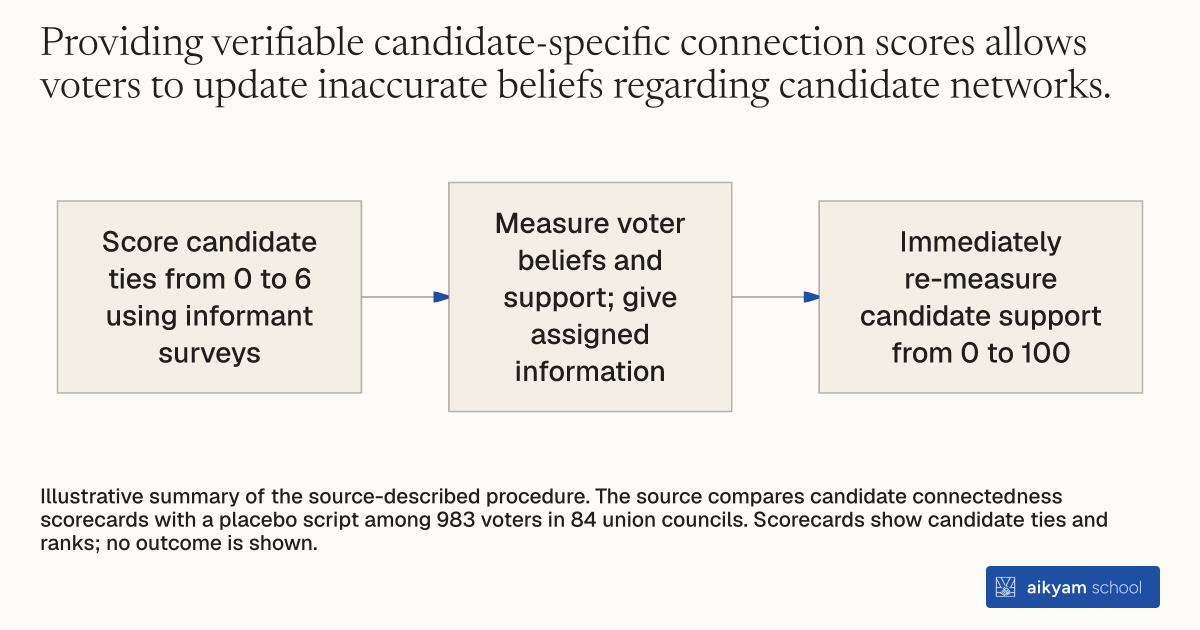
- Score candidate ties from 0 to 6 using informant surveys
- Measure voter beliefs and support; give assigned information
- Immediately re-measure candidate support from 0 to 100
Illustrative summary of the source-described procedure. The source compares candidate connectedness scorecards with a placebo script among 983 voters in 84 union councils. Scorecards show candidate ties and ranks; no outcome is shown.
See source →How
When to use
Citizens in clientelistic polities often lack objective information regarding candidates' actual networks with higher-tier government officials. Uninformed voting can lead citizens to support less connected local candidates who cannot secure development resources or bureaucratic assistance. This method provides voters with verified candidate connectedness ratings during an election campaign to evaluate whether transparency influences voter choices.
Provide voters with verified candidate connectedness cards displaying candidate ties across personal, political, and bureaucratic domains during pre-election household surveys.
- Survey local key informants across union councils to assess each chairman candidate's personal ties to sitting parliamentarians, past political campaign alliances, and petty bureaucracy connections.
- Calculate a candidate connectedness score ranging from 0 to 6 and rank candidates within each union council.
- Elicit baseline voter beliefs regarding candidate connectedness and candidate support using a 0 to 100 feeling thermometer scale during a pre-election household survey.
- Deliver a customized printed scorecard to treated respondents showing every candidate's name, party, individual connection scores, total aggregate score, and relative rank within their union council.
- Re-measure voter support on the 0 to 100 scale immediately following information provision to record changes in candidate preference.
Why it works
In settings where local municipal spending is uninformative, prospective information about higher-tier political ties provides a credible signal of a candidate's future capacity to secure development resources.
Example
Researchers provided candidate connectedness scorecards to 983 registered voters across 84 rural union councils in Sargodha district during November 2015, finding that providing information on candidate ties significantly increased voter support for highly connected candidates.
About the study
Participants
983 registered voters across 84 rural union councils in Sargodha district, Punjab province, Pakistan.
Study Design
Randomized survey field experiment with stratified sampling by union council and gender, comparing connectedness scorecards against a placebo control script.
Results
Providing voters true information on candidate connections increased expressed support for a fully connected candidate by 2 points on a 0 to 100 feeling thermometer scale (a 4.2 percentage point change) and increased the probability of a support increase by 3 percentage points.