Research groups
Allocate scarce summer jobs by lottery
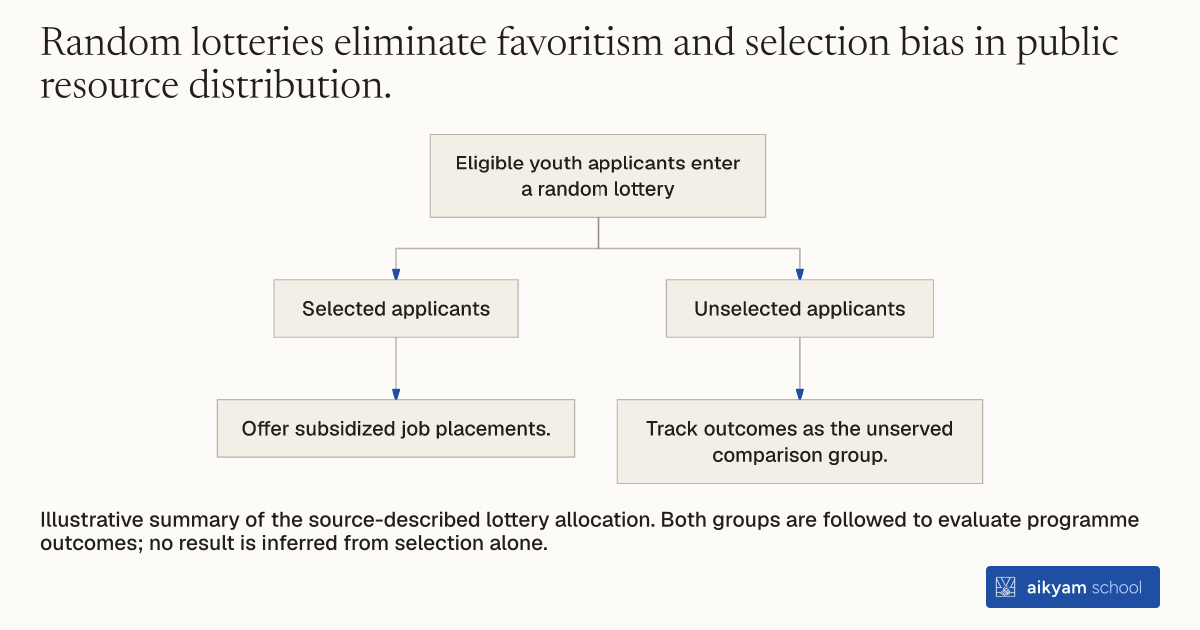
Eligible youth applicants enter a random lottery
- Selected applicants
- Offer subsidized job placements.
- Unselected applicants
- Track outcomes as the unserved comparison group.
Illustrative summary of the source-described lottery allocation. Both groups are followed to evaluate programme outcomes; no result is inferred from selection alone.
See source →How
When to use
Public youth programs often face far more qualifying applicants than available subsidized job slots. Program administrators need a fair, transparent, and unbiased method to allocate scarce program slots among low-income adolescents. Randomized lottery selection ensures equitable access while enabling rigorous evaluation of program impacts.
Allocate over-subscribed program slots to eligible youth applicants using a randomized lottery system.
- Collect standardized program applications from interested youth across targeted municipalities.
- Screen applications to confirm basic eligibility criteria such as age and neighborhood residency.
- Enter all eligible youth applicants into a centralized randomized lottery system.
- Run the lottery to assign selected applicants to available subsidized job placements.
- Notify selected participants while placing remaining applicants in an unserved control group for outcome tracking.
Why it works
They ensure equal opportunity among all qualifying applicants while creating comparable treatment and control groups to measure true intervention effects.
Example
In New York City, the Summer Youth Employment Program received 294,100 qualifying applications between 2005 and 2008 for a limited number of summer jobs, using randomized lotteries to select participants and evaluate outcomes for over 30,000 youth per year.
About the study
Participants
294,100 total applications to NYC SYEP (2005–2008 cohorts; evaluating >30,000 youth per year ages 14–21; average family income half national average) and 5,216 applicants to Chicago OSC+ (2012–2013 male youth cohorts).
Study Design
Randomized Controlled Trial (RCT) using initial and subsequent program lottery allocations to estimate causal impacts by comparing lottery winners to non-winners across administrative databases.
Results
Lottery assignment enabled researchers to determine that SYEP participation reduced 10-year prison incarceration by 0.10 percentage points (a 10 percent reduction) and reduced mortality by 0.073 percentage points (an 18 percent reduction).