Research policy design
Rotate women’s council leadership reservations
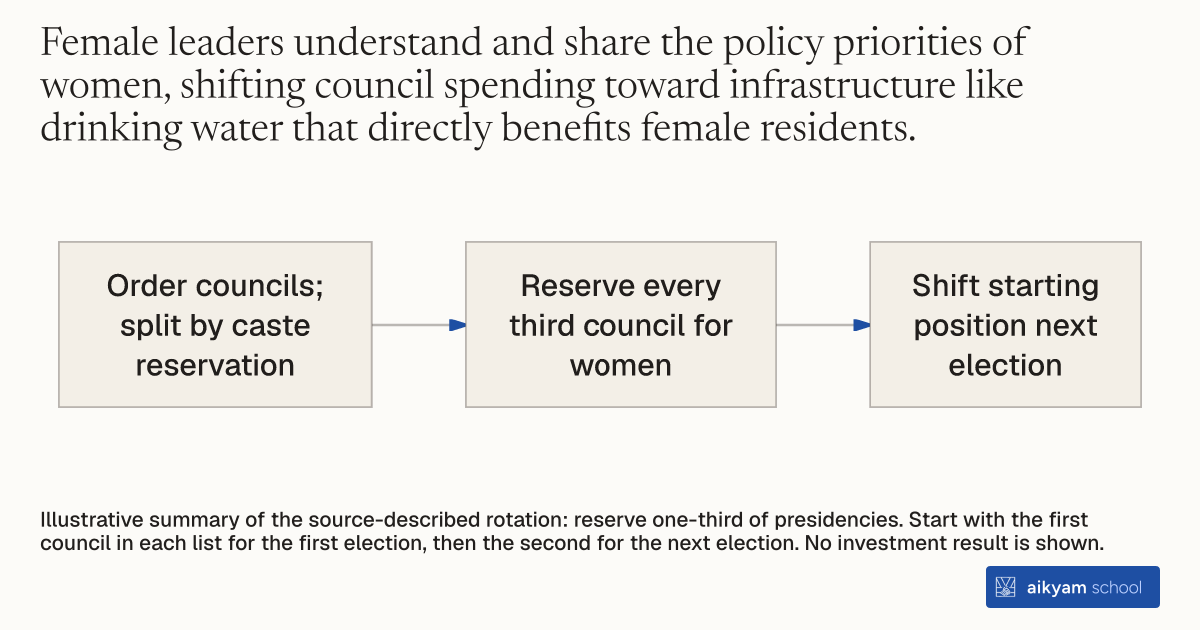
- Order councils; split by caste reservation
- Reserve every third council for women
- Shift starting position next election
Illustrative summary of the source-described rotation: reserve one-third of presidencies. Start with the first council in each list for the first election, then the second for the next election. No investment result is shown.
See source →How
When to use
Women remain massively underrepresented in political leadership due to systemic barriers and voter bias. Male politicians frequently overlook female policy priorities, such as drinking water infrastructure and road repair. Mandating a randomized rotational quota system reserves one-third of council head positions exclusively for women to align local spending with female needs.
Reserve one-third of village council presidencies for women through a randomized lottery cycle across consecutive election rounds.
- Electoral authorities compile a master list of all village councils ordered by legislative serial number within each district.
- Electoral officials divide the list into three sub-lists based on caste reservations for scheduled castes, scheduled tribes, and unreserved seats.
- Electoral commissions use a random number table from electoral law to select every third council in each sub-list for female leadership in the first election cycle.
- Electoral commissions shift the reservation cycle to select the second set of every third council in the second election cycle.
- Female council leaders select local infrastructure projects that directly match community preferences during their electoral term.
Example
In West Bengal, reserving council presidencies for women led female council heads to repair or build 23.83 drinking water facilities per village compared to 14.74 in unreserved councils.
About the study
Participants
265 village councils (165 in West Bengal and 100 in Rajasthan) covering rural populations of 10,000 people per council.
Study Design
Randomized policy experiment comparing infrastructure investment, attendance, and formal petitioning in councils randomly selected for female leadership versus unreserved councils.
Results
Reserved councils in West Bengal increased drinking water facility investments from 14.74 to 23.83 per village (+9.09) and improved road conditions from 0.23 to 0.41 (+0.18); in Rajasthan, drinking water facilities increased from 4.69 to 7.31 (+2.62).