Research comparison
Randomise the voucher recipient
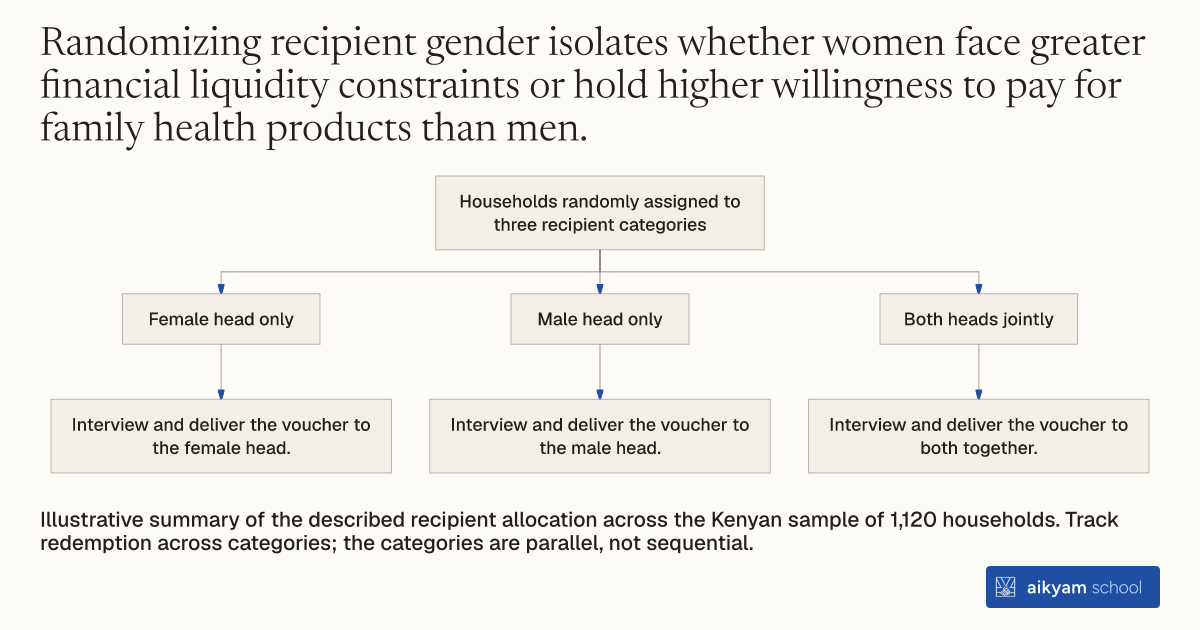
Households randomly assigned to three recipient categories
- Female head only
- Interview and deliver the voucher to the female head.
- Male head only
- Interview and deliver the voucher to the male head.
- Both heads jointly
- Interview and deliver the voucher to both together.
Illustrative summary of the described recipient allocation across the Kenyan sample of 1,120 households. Track redemption across categories; the categories are parallel, not sequential.
See source →How
When to use
In many developing countries, men and women within the same household may have different preferences, control over cash resources, or health priorities. Health programs distributing vouchers need to know whether targeting female versus male household heads affects overall product adoption. Randomly assigning whether the voucher is delivered to the husband, the wife, or both allows evaluators to test intrahousehold targeting effects cleanly.
Randomly assign whether survey enumerators interview and deliver discount vouchers to the female head, male head, or both heads jointly in sampled households.
- Identify sampled target households with both male and female household heads present.
- Randomly assign each household to one of three recipient gender arms: female head only, male head only, or both heads jointly.
- Deploy enumerators to households with specific instructions to interview and hand the discount voucher directly to the randomly designated recipient(s).
- Record baseline characteristics and voucher issuance for the designated individual recipient(s).
- Track voucher redemption rates at local retail shops to compare adoption across gender recipient categories.
Why it works
It confirms whether targeting vouchers specifically to mothers is necessary to maximize product uptake.
Example
In Western Kenya, researchers randomized whether the Olyset net voucher was given to the female head, male head, or both heads jointly across 1,120 rural households; voucher redemption rates remained virtually identical across all three recipient gender categories.
About the study
Participants
1,120 rural households across six enumeration areas in Busia District, Western Kenya.
Study Design
Cross-cutting randomized assignment of voucher recipient gender (female head, male head, or joint) during door-to-door baseline interviews.
Results
Assigning the voucher to the female head, male head, or both jointly had little to no effect on net voucher redemption rates across price levels.