Try, learn and adjust
Check delays in emergency rental assistance
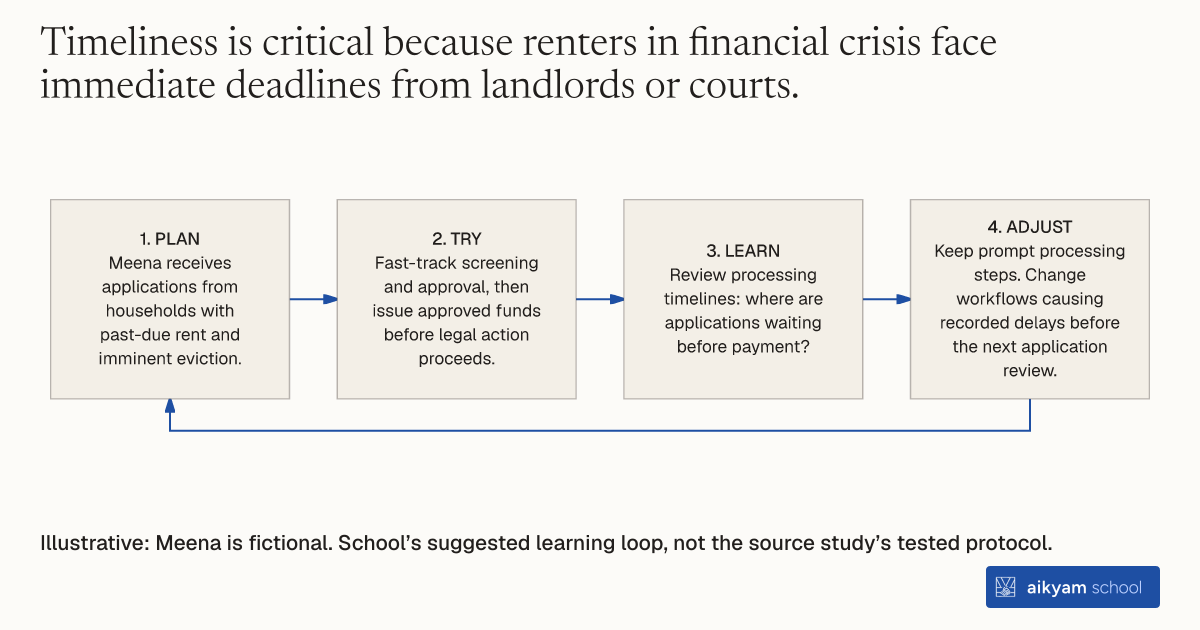
- Plan: Meena receives applications from households with past-due rent and imminent eviction.
- Try: Fast-track screening and approval, then issue approved funds before legal action proceeds.
- Learn: Review processing timelines: where are applications waiting before payment?
- Adjust: Keep prompt processing steps. Change workflows causing recorded delays before the next application review.
Illustrative: Meena is fictional. School’s suggested learning loop, not the source study’s tested protocol.
See source →Observe application-to-payment time and eviction filing deadlines. School suggests this learning loop; it is not the source’s tested procedure.
How
When to use
Applicants facing emergency rental crisis are often at imminent risk of eviction and cannot afford processing delays. Rapid administration delivers financial assistance swiftly before legal eviction filings occur. This speed protects vulnerable tenants facing urgent housing loss.
Minimize administrative processing delays to deliver emergency rental funds rapidly to households facing imminent eviction.
- Receive financial assistance applications from households facing past-due rent and imminent eviction.
- Fast-track eligibility screening and need verification to reduce administrative wait times.
- Establish streamlined approval workflows between program administrators and housing providers.
- Issue approved financial disbursements immediately to satisfy outstanding rent arrears before legal action proceeds.
- Monitor processing timelines to eliminate unnecessary operational bottlenecks.
Why it works
Swift disbursement resolves housing debt before legal eviction papers are formally filed.
Example
In emergency rental assistance evaluation studies, researchers analyzed processing delays across municipal programs to measure how turnaround time affected eviction filing rates.
About the study
Participants
Renters at imminent risk of eviction across U.S. cities applying for emergency rental assistance.
Study Design
Quasi-experimental study evaluating the causal impact of administrative wait times and processing speed on eviction filing probabilities.
Results
An additional week of wait time in receiving assistance increased the probability of an eviction filing within one year by up to 29 percent.