Try, learn and adjust
Check safety net referral connections
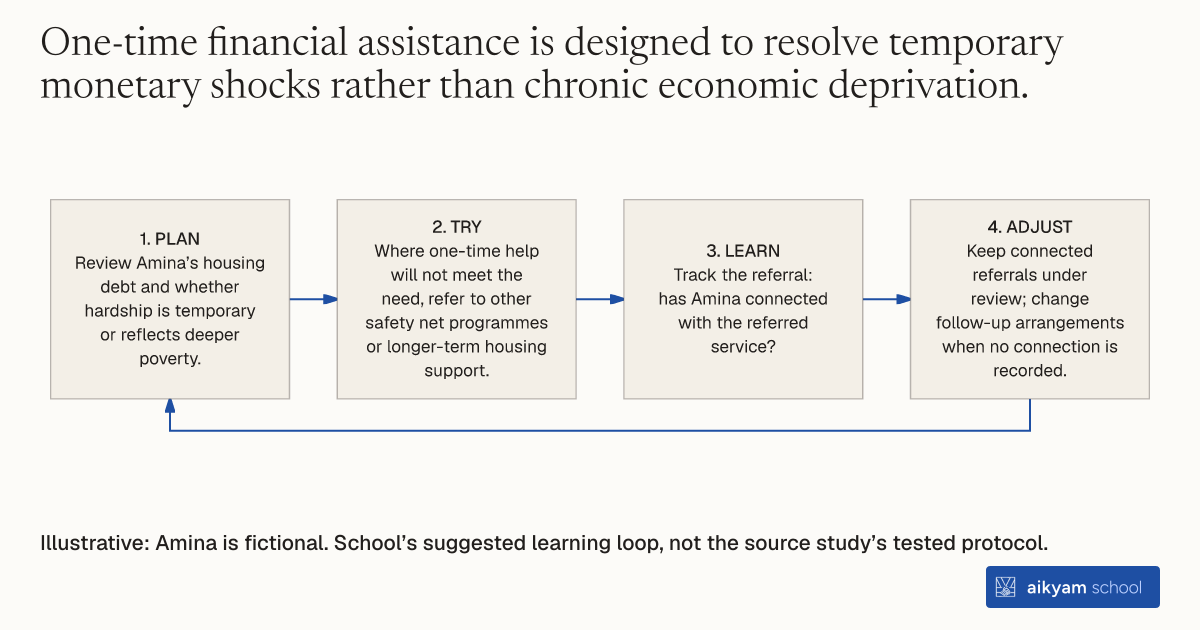
- Plan: Review Amina’s housing debt and whether hardship is temporary or reflects deeper poverty.
- Try: Where one-time help will not meet the need, refer to other safety net programmes or longer-term housing support.
- Learn: Track the referral: has Amina connected with the referred service?
- Adjust: Keep connected referrals under review; change follow-up arrangements when no connection is recorded.
Illustrative: Amina is fictional. School’s suggested learning loop, not the source study’s tested protocol.
See source →School’s suggested learning loop: Observe referral connections and access to support. This loop does not establish the effect of excluding households from emergency aid.
How
When to use
Households experiencing severe or chronic poverty apply for short-term emergency financial assistance. One-time emergency cash payments may not resolve long-term structural income deficits for these families. Referring deeper poverty households to comprehensive safety net programs connects them with appropriate long-term assistance.
Screen out applicants experiencing deeper poverty from short-term emergency assistance and refer them to other safety net programs.
- Receive emergency assistance applications and review household financial hardship details.
- Evaluate whether one-time assistance will satisfy the immediate housing debt or if the family faces deeper chronic poverty.
- Screen out applicants facing deeper poverty who require long-term welfare services rather than temporary emergency funds.
- Direct screened-out households to alternative safety net programs, public benefits, or long-term housing vouchers.
- Track referral connections to ensure households access appropriate long-term safety net services.
Why it works
Directing deeper poverty households to broader social safety net programs reserves short-term emergency funds for situations where temporary aid prevents housing loss.
Example
In Franklin County, Ohio, the Prevention, Retention, and Contingency program screens applicants and refers families facing deeper poverty to other safety net programs.
About the study
Participants
Low-income renters and families applying for emergency assistance in Franklin County, Ohio.
Study Design
Programmatic evaluations and randomized controlled trials of emergency financial assistance targeting strategies.
Results
The programmatic cost of averting an episode of homelessness was 35 percent lower for very low-income families than for the full sample.