Research measurement
Record malaria test results during household visits
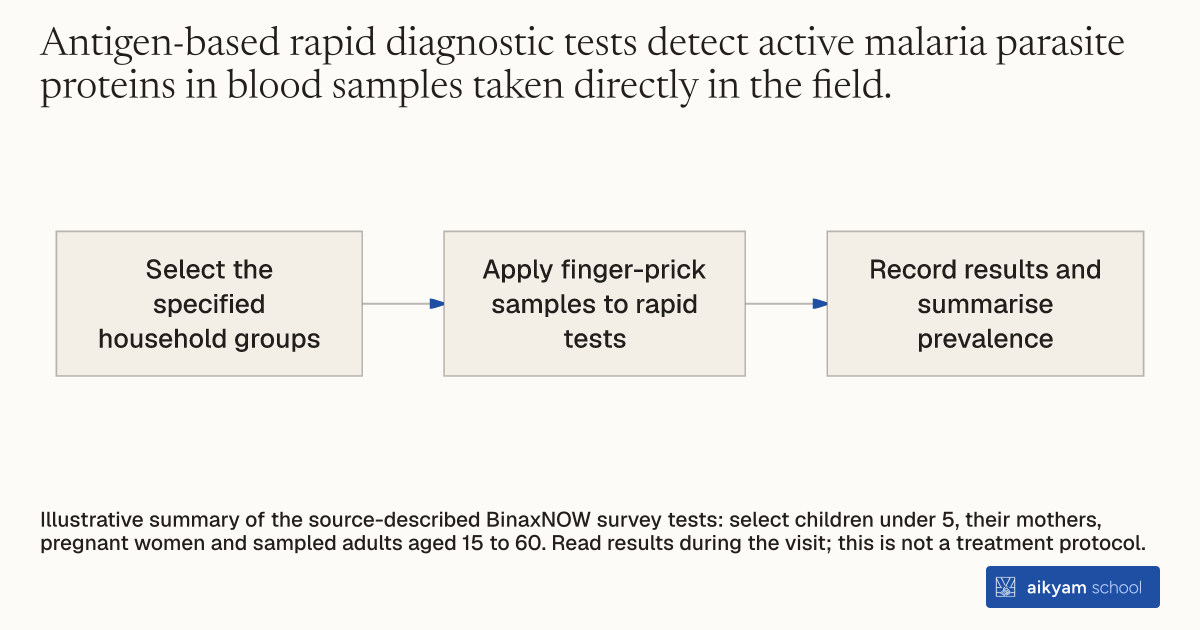
- Select the specified household groups
- Apply finger-prick samples to rapid tests
- Record results and summarise prevalence
Illustrative summary of the source-described BinaxNOW survey tests: select children under 5, their mothers, pregnant women and sampled adults aged 15 to 60. Read results during the visit; this is not a treatment protocol.
See source →How
When to use
Health programs in endemic rural regions need accurate measures of active malaria infections. Self-reported fever symptoms often misstate actual infection rates due to non-malarial fevers or asymptomatic parasitemia. Rapid diagnostic blood testing provides field survey teams with immediate objective biomarker data on current malaria infection.
Screen targeted household members for current malaria infection by administering antigen-based rapid diagnostic blood tests during household survey visits.
- Identify high-risk household members including children under five, their mothers, pregnant women, and a random sample of working-age adults aged 15 to 60.
- Obtain a finger-prick blood sample from each selected participant during the household field survey.
- Apply the blood sample to a BinaxNOW rapid diagnostic test card to detect malaria antigens.
- Read and record the test result during the visit to determine current Plasmodium falciparum or mixed malaria infection.
- Combine diagnostic results across sampled individuals to estimate population-level malaria prevalence.
Why it works
This objective biomarker eliminates recall bias and captures current infections that self-reported health surveys miss.
Example
Survey teams tested 2,621 individuals across 1,947 households in 150 rural villages of Orissa, India, during May–June 2007. The tests revealed a 12 percent overall malaria positivity rate, with almost all positive cases showing falciparum infection.
About the study
Participants
2,621 individuals tested across 1,947 households in 150 villages in Bargarh, Balangir, Kandhamal, Keonjhar, and Sambalpur districts in Orissa, India, where over 90 percent of households belong to Scheduled Castes, Scheduled Tribes, or Other Backward Castes.
Study Design
Survey monitors administered BinaxNOW antigen-based rapid diagnostic blood tests to children under five, their mothers, pregnant women, and a random sample of adults aged 15 to 60 during a household baseline survey.
Results
Overall malaria prevalence at the time of testing was 12 percent across 2,621 tested blood samples, with infection almost exclusively driven by Plasmodium falciparum.