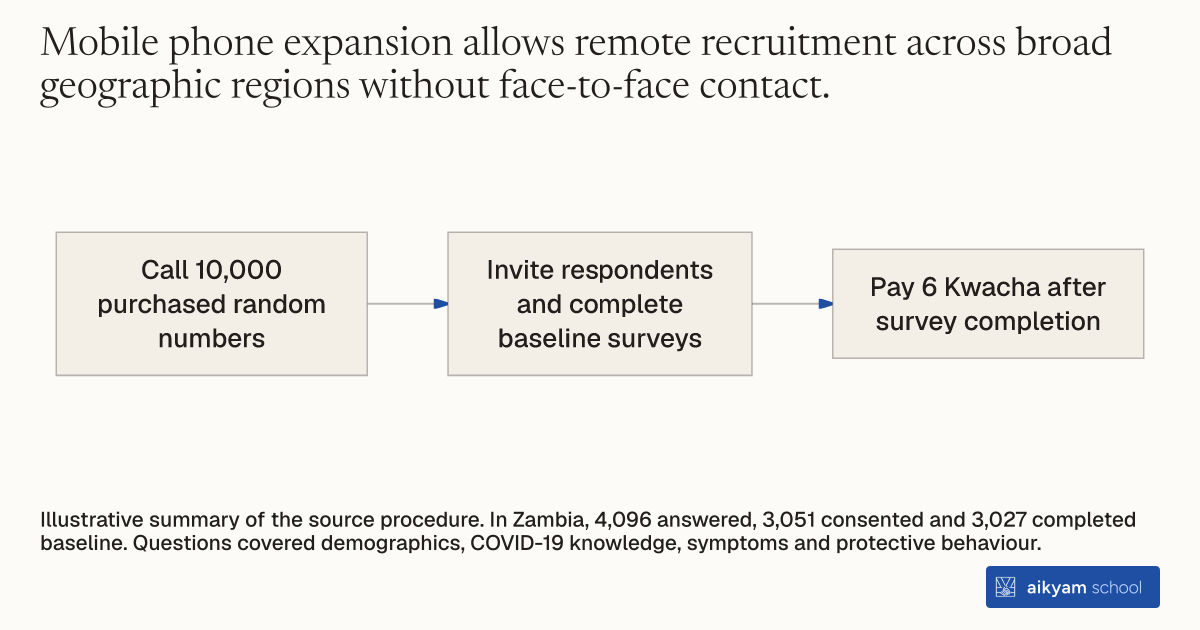
Research procedure
Recruit and survey phone respondents
- Call 10,000 purchased random numbers
- Invite respondents and complete baseline surveys
- Pay 6 Kwacha after survey completion
Illustrative summary of the source procedure. In Zambia, 4,096 answered, 3,051 consented and 3,027 completed baseline. Questions covered demographics, COVID-19 knowledge, symptoms and protective behaviour.
See source →How
When to use
Public health emergencies require rapid gathering of baseline health data from a broad population. In-person household surveys can be unsafe or impractical during an epidemic. Random phone dialing allows research teams to quickly reach mobile phone users and enroll them in health monitoring programs.
Recruit a representative sample of phone users and gather baseline health data using random digit dialing.
- Purchase a list of 10,000 random cell phone numbers from a commercial vendor.
- Call potential participants daily using trained survey enumerators.
- Invite call respondents to join the study and complete a baseline questionnaire.
- Measure participant demographics, COVID-19 knowledge, household symptoms, and current protective health behaviors.
- Pay respondents a completion incentive of 6 Kwacha in mobile money upon finishing the survey.
Why it works
Immediate mobile money transfers encourage respondents to complete survey questions and stay engaged with research teams.
Example
Field teams in Zambia attempted 10,000 phone numbers purchased from a commercial firm. Enumerators reached 4,096 people, obtaining consent from 3,051 individuals and baseline survey completion from 3,027 respondents who each received 6 Kwacha.
About the study
Participants
3,027 baseline respondents aged 18 and older in Zambia, with 45.7% female, 47.6% aged 20-29, 45.9% with secondary education, and 34.6% residing in Lusaka province.
Study Design
Survey enumerators made daily calls to a purchased list of 10,000 random digit phone numbers across two implementation waves in 2021.
Results
Out of 10,000 attempted numbers, 4,096 answered, 3,051 consented (74.5%), and 3,027 completed the baseline survey (73.9%).