Research design
Randomly delay rate activation
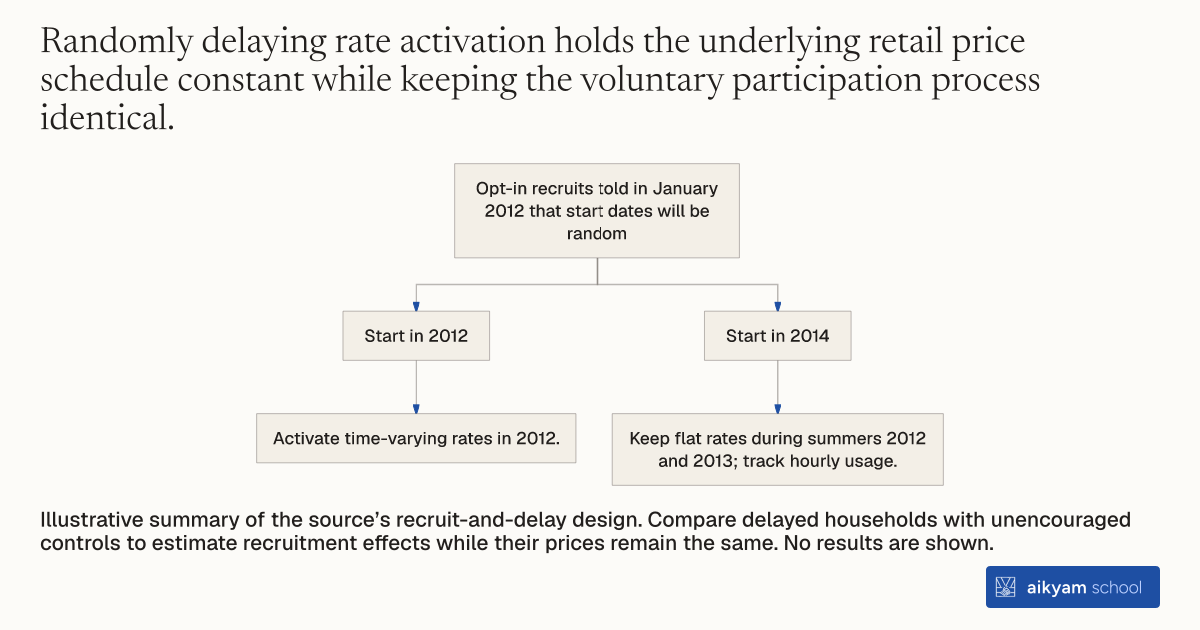
Opt-in recruits told in January 2012 that start dates will be random
- Start in 2012
- Activate time-varying rates in 2012.
- Start in 2014
- Keep flat rates during summers 2012 and 2013; track hourly usage.
Illustrative summary of the source’s recruit-and-delay design. Compare delayed households with unencouraged controls to estimate recruitment effects while their prices remain the same. No results are shown.
See source →How
When to use
Experimental economists and program evaluators need to isolate the pure encouragement and information salience effects of enrolling in a program from the price effect itself. Standard opt-in designs cannot separate behavioral changes caused by program marketing from changes caused by tariff rates. A recruit-and-delay design recruits participants into a program but randomly delays pricing activation for a subset to establish an unconfounded baseline.
Implement a recruit-and-delay randomized controlled trial protocol to isolate non-price encouragement effects among program enrollees.
- Program administrators mail recruitment packets inviting eligible households to opt into a time-varying electricity rate program.
- Recruitment materials inform participants in January 2012 that enrollees will be randomly assigned to start the program in either 2012 or 2014.
- Operations staff process enrollments and randomly assign participating households to either immediate rate activation in 2012 or delayed rate activation in 2014.
- Data analysts track hourly smart meter consumption for the delayed enrollment group while they remain on standard flat rates during the 2012 and 2013 summers.
- Econometricians compare the delayed cohort's usage against the unencouraged control group to estimate the pure salience and marketing effect.
Why it works
This isolates whether recruitment communications and program sign-ups directly alter consumer energy habits independently of price signals.
Example
SMUD recruited residential households into a Time-of-Use rate program in Sacramento, California where opt-in participants faced random assignment to start in 2012 or 2014, revealing that delayed households on standard rates still reduced usage by 0.09 kWh during event hours due to initial recruitment salience.
About the study
Participants
58,532 residential customer-hours evaluated across control and recruit-and-delay opt-in households in Sacramento, California.
Study Design
Randomized controlled trial comparing delayed TOU opt-in enrollees on standard rates against unencouraged control households across 2012–2013 summers.
Results
Delayed enrollees who remained on standard flat prices reduced usage by 0.098 kWh during critical event hours (p < 0.05) and 0.083 kWh during non-event peak hours (p < 0.01) in the first year, with treatment attenuation of 59 percent occurring by the second summer.