Try, learn and adjust
Check scripted myths receive on-air corrections
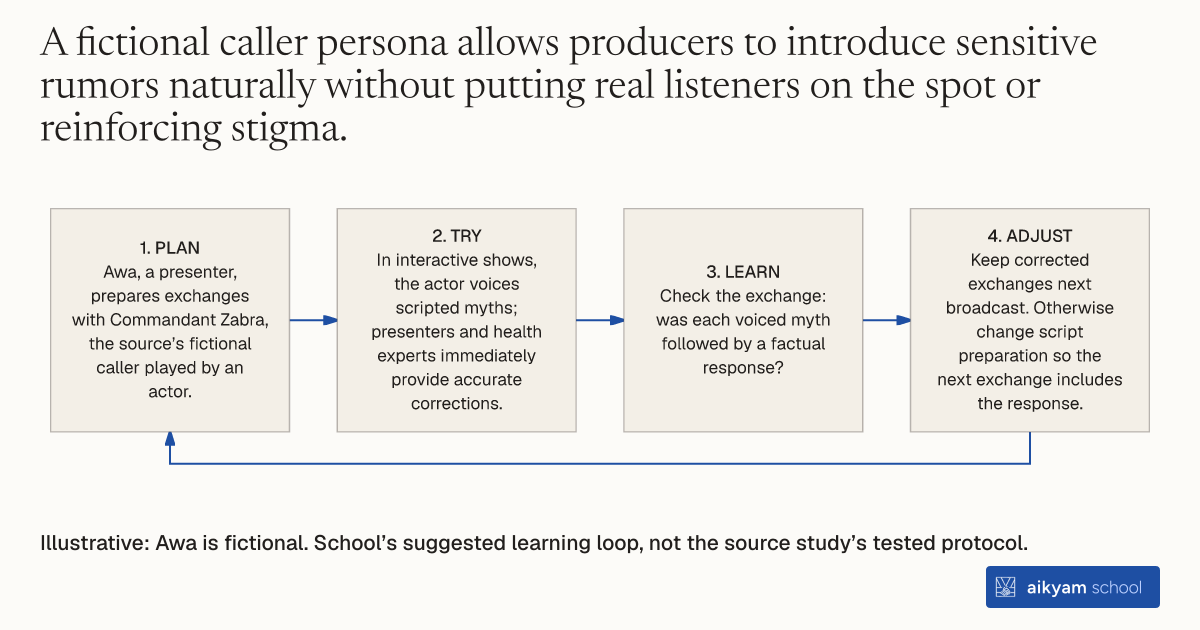
- Plan: Awa, a presenter, prepares exchanges with Commandant Zabra, the source’s fictional caller played by an actor.
- Try: In interactive shows, the actor voices scripted myths; presenters and health experts immediately provide accurate corrections.
- Learn: Check the exchange: was each voiced myth followed by a factual response?
- Adjust: Keep corrected exchanges next broadcast. Otherwise change script preparation so the next exchange includes the response.
Illustrative: Awa is fictional. School’s suggested learning loop, not the source study’s tested protocol.
See source →School’s suggested, untested learning loop. Observe scripted calls and factual responses. The caller is fictional; campaign effects do not isolate this component.
How
When to use
Public health communications often fail to dismantle deeply held community myths because standard announcements do not address sensitive rumors directly. Media campaign producers want a non-threatening way to surface widespread misinformation on live radio shows without validating harmful gossip or alienating listeners. Using a recurring fictional caller persona during interactive broadcasts allows producers to introduce common misconceptions and dismantle them in a structured format.
Introduce a recurring fictional caller character during live radio broadcasts to voice widespread local myths and spark structured on-air corrections.
- Script a recurring fictional persona, such as an actor portraying a skeptical caller, to embody common local misconceptions.
- Schedule three 1-hour interactive phone-in shows per week on local radio stations during peak listening hours.
- Station hosts initiate live discussions and receive simulated incoming phone calls from the hired actor persona.
- The actor voices specific community rumors about modern health technologies, such as modern contraceptives causing permanent sterility or illness.
- Radio station presenters and health experts immediately respond by providing accurate medical facts and addressing the expressed fears.
- Program teams air these structured call-in exchanges consistently across a multi-year broadcast campaign to replace local myths with reliable health information.
Why it works
Hearing a relatable character express familiar doubts creates an engaging entry point for health experts to systematically present accurate medical evidence.
Example
In Burkina Faso, Development Media International introduced a recurring fictional caller named "Commandant Zabra," played by an actor, across three weekly interactive phone-in programs on 8 radio stations. The character regularly called in to express common myths about modern contraceptives, enabling hosts to combat misinformation in a structured way across an audience of 5.1 million people. This strategy contributed to a 9 percentage point drop in the belief that modern methods cause sterility.
About the study
Participants
7,515 women and 461 health clinics across 16 radio station clusters reaching 5.1 million people in rural Burkina Faso.
Study Design
Pairwise randomized controlled trial evaluating an intensive 2.5-year radio campaign with interactive myth-busting phone-in programming across 8 treatment radio stations.
Results
Misperceptions that modern contraceptives cause sterility fell by 9 percentage points (from 26 percent to 17 percent), concerns about sickness fell by 8 percentage points, and modern contraceptive prevalence increased by 5.9 percentage points.