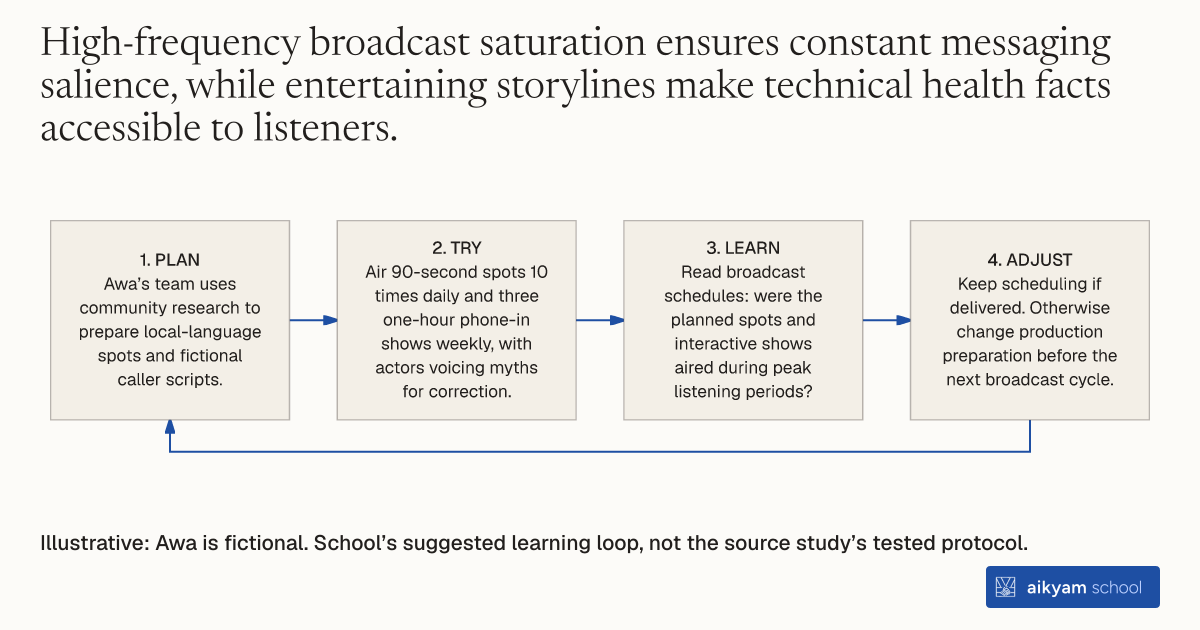
Try, learn and adjust
Check delivery of the intensive radio campaign
- Plan: Awa’s team uses community research to prepare local-language spots and fictional caller scripts.
- Try: Air 90-second spots 10 times daily and three one-hour phone-in shows weekly, with actors voicing myths for correction.
- Learn: Read broadcast schedules: were the planned spots and interactive shows aired during peak listening periods?
- Adjust: Keep scheduling if delivered. Otherwise change production preparation before the next broadcast cycle.
Illustrative: Awa is fictional. School’s suggested learning loop, not the source study’s tested protocol.
See source →School’s suggested, untested learning loop. Observe broadcast frequency, timing and scripted corrections. This loop does not establish the campaign’s health effects.
How
When to use
In low-income rural areas with high fertility, modern contraception remains underused despite general availability because of widespread misconceptions and social pressure. Public health organizations want to shift community knowledge and increase health technology adoption without relying on direct door-to-door counseling. This approach targets women of reproductive age and their partners living in broad radio broadcast coverage zones.
Deliver high-frequency, evidence-based radio broadcasts combining short dramatic spots and interactive phone-in programming to shift family planning practices across broadcast areas.
- Formative research teams conduct qualitative field interviews to map local misconceptions and barriers regarding modern contraceptives.
- Production teams design 90-second radio spots in local languages focusing on specific key myths and emotional decision moments.
- Radio station operators broadcast the 90-second spots 10 times daily, concentrating broadcasts during peak early morning and evening listening hours.
- Broadcast crews air three 1-hour interactive phone-in shows each week featuring local station hosts and trained actors.
- Actors play recurring fictive caller personas who voice common community myths to trigger structured on-air corrections.
- Program managers maintain continuous broadcast schedules over a multi-year campaign duration to sustain messaging salience.
Why it works
Addressing specific side-effect myths directly replaces unreliable community gossip with accurate medical information.
Example
In Burkina Faso, Development Media International broadcasted 195 hours of health programming annually across 8 local treatment radio stations covering an estimated 5.1 million people. Over 2.5 years, the campaign aired 90-second spots 10 times per day alongside three weekly interactive phone-in shows. Modern contraceptive adoption increased significantly among target women, and total consultations at nearby clinics rose by 32 percent.
About the study
Participants
7,515 women and 461 health clinics across 16 radio station broadcast zones covering 5.1 million people in rural Burkina Faso.
Study Design
Pairwise randomized controlled trial allocating 16 geographically distinct radio stations to either a 2.5-year campaign or standard broadcasting, combined with household radio distribution.
Results
Modern contraceptive prevalence increased by 5.9 percentage points (a 20 percent increase over the 29.5 percent control mean), misperceptions about sterility fell by 9 percentage points (35 percent reduction), and clinic consultations rose by 32 percent.