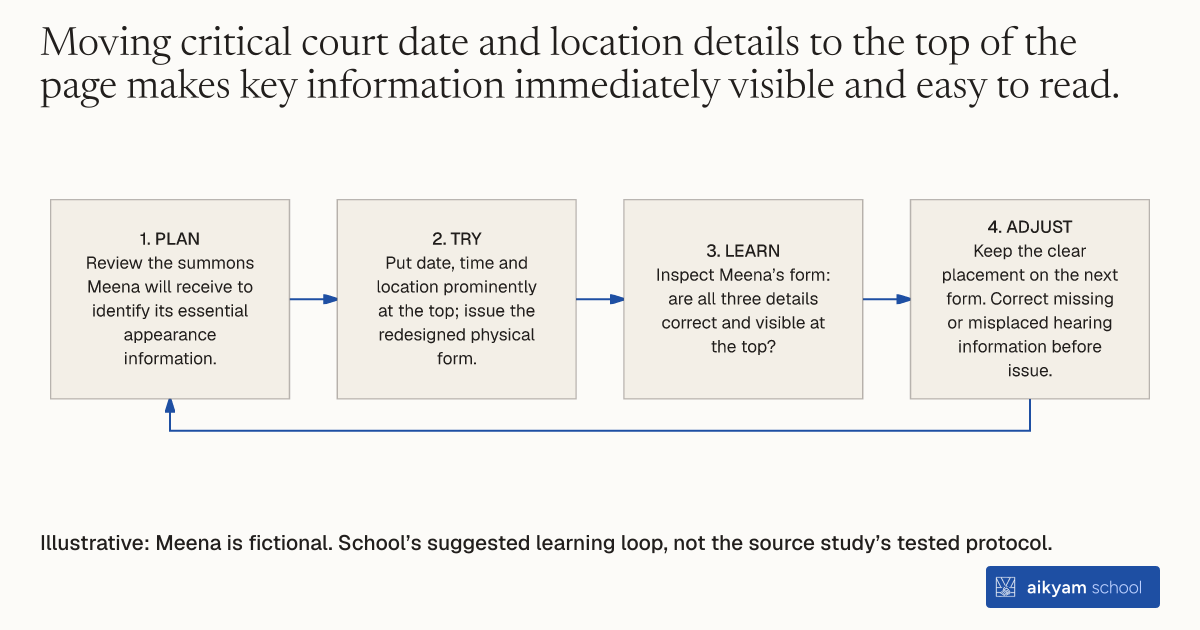
Try, learn and adjust
Check key hearing details appear at the top
- Plan: Review the summons Meena will receive to identify its essential appearance information.
- Try: Put date, time and location prominently at the top; issue the redesigned physical form.
- Learn: Inspect Meena’s form: are all three details correct and visible at the top?
- Adjust: Keep the clear placement on the next form. Correct missing or misplaced hearing information before issue.
Illustrative: Meena is fictional. School’s suggested learning loop, not the source study’s tested protocol.
See source →School’s suggested, untested loop. Observe the form’s content and placement; this check does not establish attendance effects.
How
When to use
Many individuals served with a court summons fail to appear because critical hearing information is buried on standard paperwork. Standard summons forms emphasize legal jargon over appearance dates, leaving defendants confused about when and where to report. Redesigning court summons forms to highlight critical dates and locations at the top improves clarity for individuals facing court appearances.
Redesign court summons forms to place essential appearance dates, times, and location details prominently at the top of the page.
- Court policy designers review the standard summons document to identify critical information needed by defendants.
- Designers relocate key details, such as the date, time, and location of the court appearance, to the top of the form.
- Law enforcement or court officers issue the redesigned physical summons form directly to individuals when citing them.
- Recipients review the prominently displayed hearing information at the top of the form to plan their court appearance.
Why it works
This reduces unintentional non-attendance caused by forgetfulness, human error, or misplaced details buried in paperwork.
Example
In New York City, legal authorities issued a redesigned court summons form with key date and location details placed at the top of the page, which reduced failure to appear rates by 6.2 percentage points.
About the study
Participants
Individuals awaiting arraignment after receiving a court summons in New York City.
Study Design
Randomized evaluation testing the redesigned summons form against the standard form with a 47 percent baseline failure to appear rate.
Results
Receiving a redesigned summons form alone reduced failure to appear rates by 6.2 percentage points, or by 13.2 percent from the 47 percent baseline failure to appear rate.