Try, learn and adjust
Check unused vouchers reach other farmers
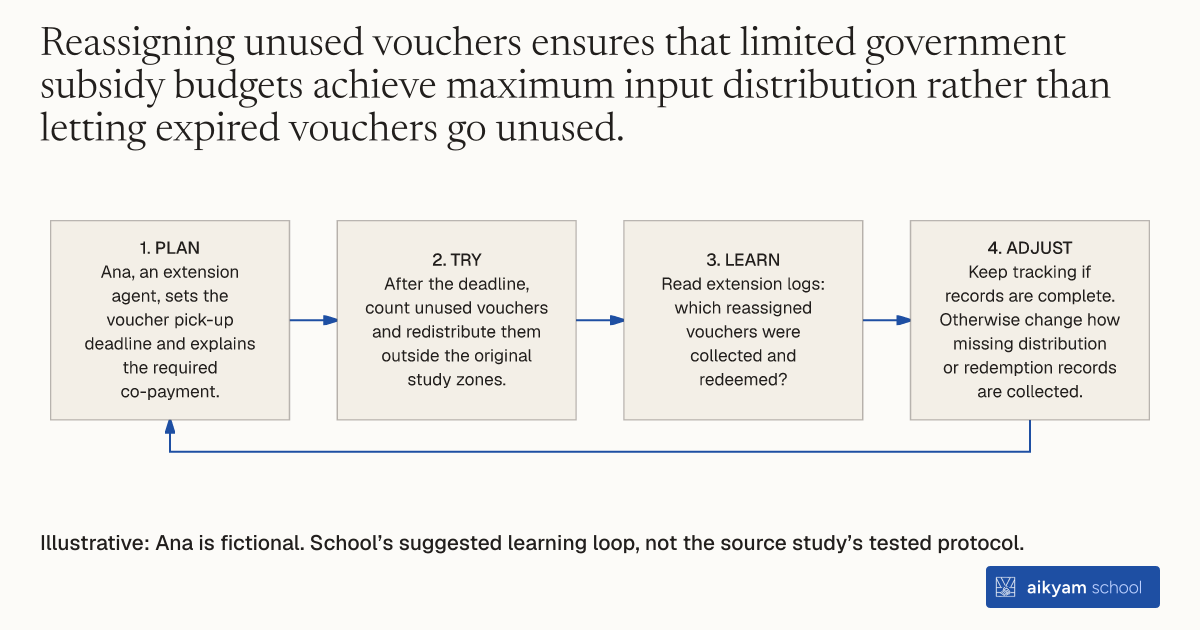
- Plan: Ana, an extension agent, sets the voucher pick-up deadline and explains the required co-payment.
- Try: After the deadline, count unused vouchers and redistribute them outside the original study zones.
- Learn: Read extension logs: which reassigned vouchers were collected and redeemed?
- Adjust: Keep tracking if records are complete. Otherwise change how missing distribution or redemption records are collected.
Illustrative: Ana is fictional. School’s suggested learning loop, not the source study’s tested protocol.
See source →School’s suggested learning loop: observe unused vouchers, reassignment and redemption; not a new allocation protocol.
How
When to use
In agricultural subsidy voucher programs, many winning smallholders fail to pick up their allocated coupons due to liquidity shortages or absence during distribution. Leaving these vouchers unused wastes public subsidy funds and lowers overall program technology adoption. This method directs agricultural extension services to reassign unclaimed vouchers to alternative farmers so that available subsidized inputs are fully utilized across farming communities.
Reallocate unclaimed agricultural input vouchers through local extension workers to secondary smallholders after initial lottery winners fail to collect them.
- Establish a clear pick-up deadline for lottery-selected farmers to collect their voucher coupons from distribution sites.
- Direct agricultural extension agents to advise winning farmers not to pick up vouchers if they lack the mandatory co-payment funds.
- Conduct an inventory check at extension service offices after the deadline to aggregate all uncollected and declined vouchers.
- Mandate that extension agents reassign and redistribute the unclaimed vouchers to other smallholder farmers outside original study zones to prevent sample contamination.
- Track the reassigned voucher distribution through extension logs to account for secondary recipient redemption at local agro-dealers.
Why it works
It leverages local extension agents' direct contact with farmers to identify alternative producers who possess the required co-payment capital.
Example
In Manica Province, Mozambique, the agricultural extension service was tasked with redistributing unused input vouchers after 50% of lottery winners failed to pick up their coupons. Extension agents collected unclaimed vouchers and distributed them to secondary farmers. This administrative redistribution, alongside direct requests from lottery non-winners, led to 12% of control group lottery losers obtaining a voucher coupon and 6% using it for maize production.
About the study
Participants
N = 1,436 smallholder maize producers (795 treatment group lottery winners, 798 control group lottery losers) across 75 villages in Manica Province, Mozambique.
Study Design
Randomized Controlled Trial (RCT) tracking voucher pick-up, redistribution, and leakage across treatment winners and control group losers.
Results
Reallocating unclaimed vouchers through extension services contributed to 12% of control group lottery losers receiving a voucher and 6% using it for maize; among winning households, 46% of non-pickups resulted from lacking the USD 32 co-payment, 17% from absence, and 16% from late voucher distribution.