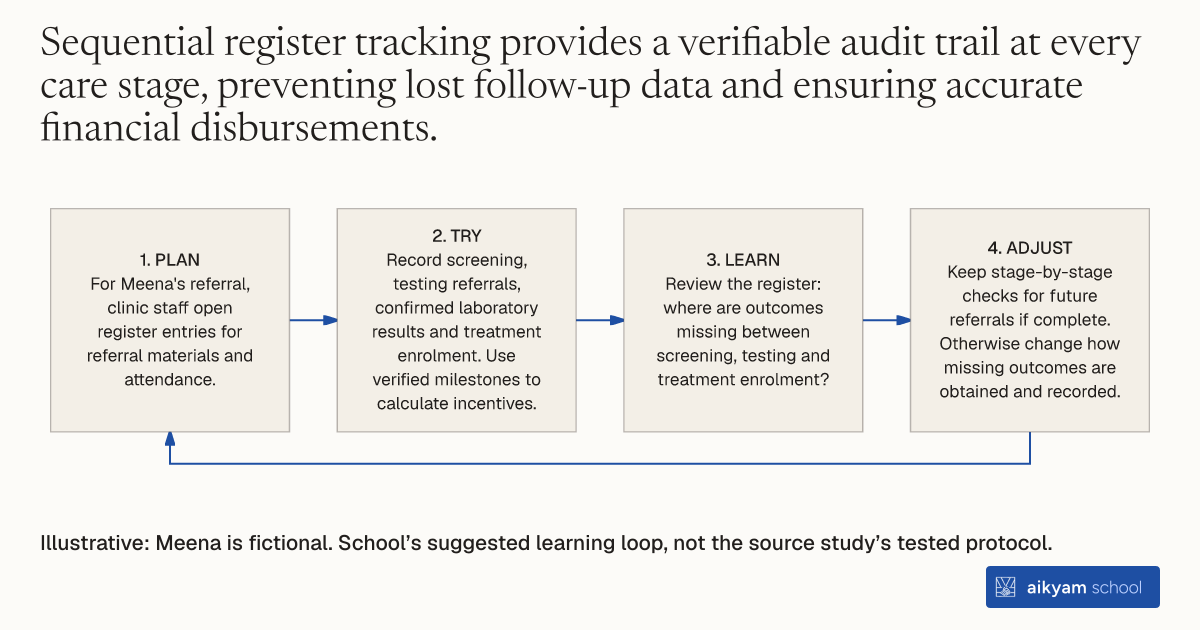
Try, learn and adjust
Check referral records cover each care stage
- Plan: For Meena's referral, clinic staff open register entries for referral materials and attendance.
- Try: Record screening, testing referrals, confirmed laboratory results and treatment enrolment. Use verified milestones to calculate incentives.
- Learn: Review the register: where are outcomes missing between screening, testing and treatment enrolment?
- Adjust: Keep stage-by-stage checks for future referrals if complete. Otherwise change how missing outcomes are obtained and recorded.
Illustrative: Meena is fictional. School’s suggested learning loop, not the source study’s tested protocol.
See source →School's suggested, untested loop: observe care-stage entries and incentive milestones. This is not a tested clinical protocol.
How
When to use
Tracking referred individuals through multiple health screening and diagnostic stages is difficult across fragmented health centers. Health workers need systematic record-keeping to follow individuals from initial peer referral through clinical screening, laboratory testing, and treatment enrollment. Clinics maintain referral registers to log outcomes and verify program performance at each operational step.
Record patient referrals and subsequent health outcomes sequentially in dedicated referral registers across clinic visits.
- Community health workers log referral cards given to or brought in by patients in clinic referral registers.
- Health workers record whether referred individuals present for initial health screening at the treatment center.
- Clinic staff document clinical screening findings and register whether symptomatic individuals are sent for lab testing.
- Health workers record diagnostic lab test results upon receiving confirmation from government testing centers.
- Program staff record whether newly diagnosed patients enroll in active disease treatment.
- Program administrators use completed register entries to verify referral milestones and calculate incentive payments.
Example
In India, Operation ASHA centers used referral registers across 10 cities to track 216 screened individuals, recording 170 symptomatic cases, 123 government lab tests, 35 active tuberculosis diagnoses, and subsequent treatment enrollments.
About the study
Participants
3,176 urban tuberculosis patients and 216 referred contacts across 122 Operation ASHA centers in 10 Indian cities.
Study Design
Programmatic monitoring integrated into a randomized trial using clinic referral registers to record patient screening, lab testing, test results, and treatment enrollment.
Results
Register tracking documented 216 screened individuals, 170 symptomatic referrals (78.7 percent), 123 lab test visits, 35 active tuberculosis cases (28 percent infection rate), and enrolled patients.