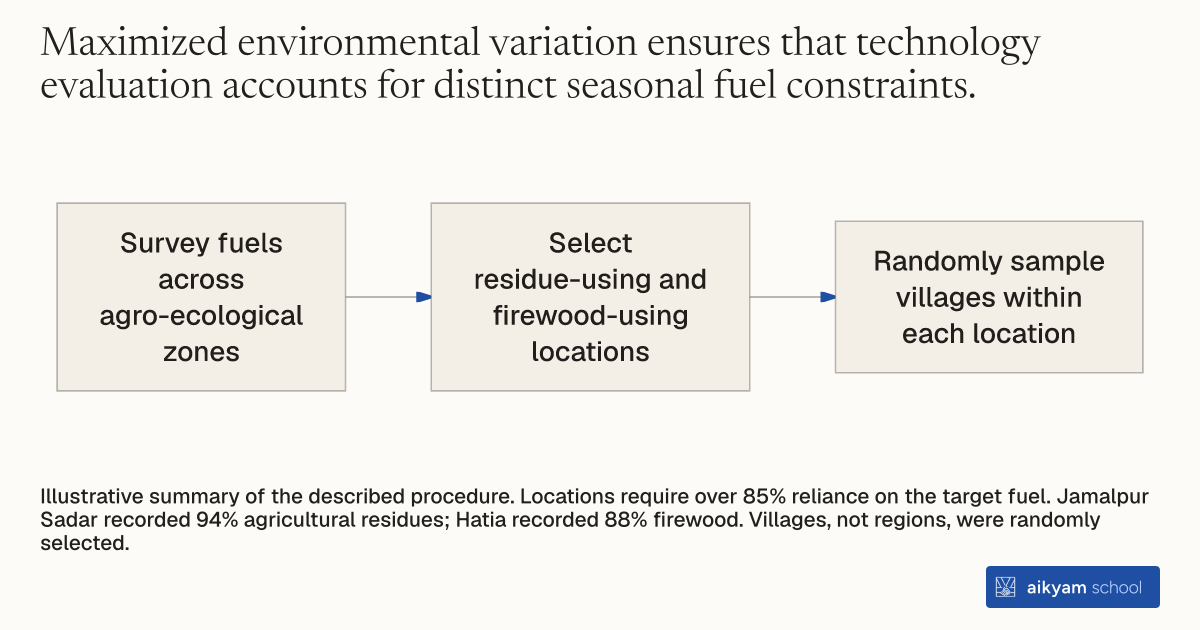
Research procedure
Select contrasting fuel-use regions
- Survey fuels across agro-ecological zones
- Select residue-using and firewood-using locations
- Randomly sample villages within each location
Illustrative summary of the described procedure. Locations require over 85% reliance on the target fuel. Jamalpur Sadar recorded 94% agricultural residues; Hatia recorded 88% firewood. Villages, not regions, were randomly selected.
See source →How
When to use
Researchers need to select field study sites across diverse geographic regions to test technology adoption. Broad national variations in fuel availability can make single-location findings misleading. This method provides a clear way to choose representative rural locations based on dominant household fuel types.
Select representative study regions based on dominant household biomass fuel types across distinct agro-ecological areas.
- Survey households across major national agro-ecological zones to identify dominant cooking fuels.
- Filter administrative units to find locations where over 85 percent of households rely on a single target fuel type.
- Select one inland agricultural location where over 85 percent of households burn agricultural residues.
- Select one coastal location where over 85 percent of households burn firewood.
- Randomly draw sample villages from each selected location using a national sampling frame.
Why it works
Comparing distinct zones reveals whether adoption barriers stem from regional fuel characteristics or general economic factors.
Example
Researchers in Bangladesh selected Jamalpur Sadar where 94 percent of households used agricultural residues and Hatia where 88 percent used firewood to sample 58 villages for a cookstove study.
About the study
Participants
2,400 households in a preliminary survey and 3,080 households across 58 villages in Jamalpur Sadar and Hatia upazilas, Bangladesh.
Study Design
Multi-region preliminary survey followed by purposive selection of two contrasting upazilas and random sampling of 29 villages per upazila.
Results
Jamalpur Sadar captured 94 percent agri-residue fuel reliance and Hatia captured 88 percent firewood reliance, providing maximum contrast in environmental and fuel conditions across 58 study villages.