Research procedure
Compare regional vacancy changes
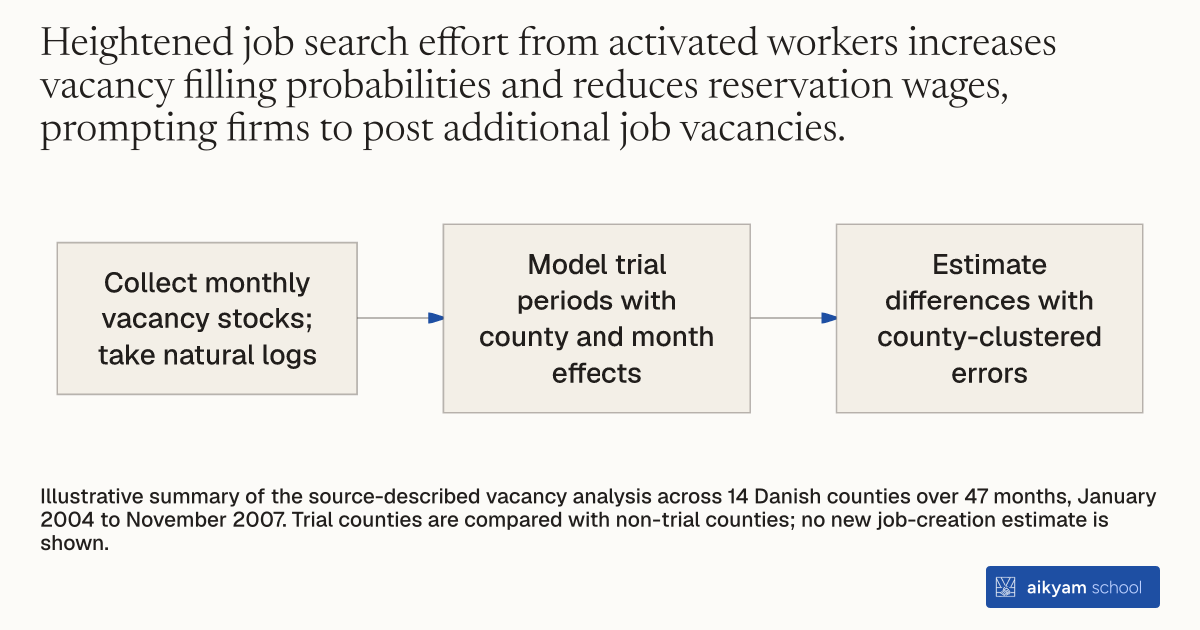
- Collect monthly vacancy stocks; take natural logs
- Model trial periods with county and month effects
- Estimate differences with county-clustered errors
Illustrative summary of the source-described vacancy analysis across 14 Danish counties over 47 months, January 2004 to November 2007. Trial counties are compared with non-trial counties; no new job-creation estimate is shown.
See source →How
When to use
Program evaluators want to determine whether an active labor market intervention affects firm job creation and regional labor demand. Comparing raw vacancy numbers without controlling for macro trends can confuse business cycle movements with program impacts. Estimating a regional difference-in-differences model on log vacancy stocks measures whether employer job creation responds to labor policy changes.
Estimate a linear difference-in-differences regression model on monthly logarithmic vacancy stocks across experiment and comparison regions to measure labor demand adjustments.
- Collect monthly average open vacancy counts from public job centers across all target trial counties and non-trial comparison counties.
- Transform monthly county vacancy stock counts into natural logarithms to account for baseline differences in regional labor market sizes.
- Define time-varying treatment indicator variables corresponding to the active trial months and post-trial follow-up windows.
- Include monthly fixed effects to control for national business cycle movements and seasonal hiring trends across all regions.
- Include county fixed effects to absorb time-invariant structural labor market differences between experiment and comparison regions.
- Estimate the regression parameters using cluster-robust standard errors grouped at the county level to adjust for monthly error autocorrelation.
Why it works
Comparing logarithmic vacancy changes between trial and comparison counties controls for macroeconomic shocks affecting all regions.
Example
Researchers evaluated monthly vacancy counts across 14 Danish counties from January 2004 to November 2007 during the activation experiment in Storstrøm and South Jutland. The difference-in-differences model showed that log vacancy stocks in experiment regions increased by 18.2% three to four months after random assignment ended (May/June 2006).
About the study
Participants
Monthly vacancy stock records across 14 Danish counties tracked over 47 months from January 2004 to November 2007.
Study Design
Difference-in-differences regression of log monthly vacancy stocks with county fixed effects, month fixed effects, and cluster-robust standard errors.
Results
Monthly log vacancy stocks in experiment counties increased significantly, peaking at an 18.2% increase (p < 0.01) in May/June 2006 compared to non-experiment counties.