Research targeting
Rank localities before selection
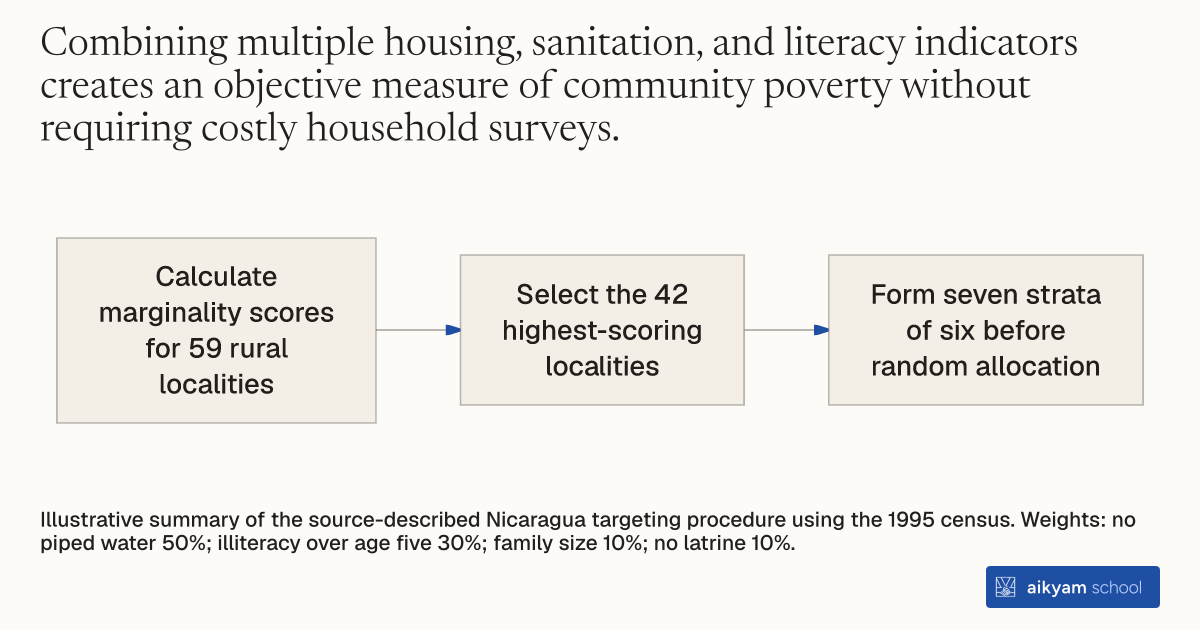
- Calculate marginality scores for 59 rural localities
- Select the 42 highest-scoring localities
- Form seven strata of six before random allocation
Illustrative summary of the source-described Nicaragua targeting procedure using the 1995 census. Weights: no piped water 50%; illiteracy over age five 30%; family size 10%; no latrine 10%.
See source →How
When to use
Program managers need to select the poorest rural localities for social protection interventions when individual poverty data is absent. Geographic targeting using census indicators identifies areas with the highest concentration of poverty. This method ensures resources reach impoverished rural communities efficiently.
Target rural localities by constructing a weighted marginality index from national population census indicators to rank and select the most impoverished comarcas.
- Program analysts obtain administrative data for all rural census comarcas in targeted municipalities from the national population census.
- Program analysts calculate a locality marginality index using four weighted census indicators: percent without piped water in the home or yard (50 percent), percent illiterate over age five (30 percent), average family size (10 percent), and percent without a latrine (10 percent).
- Program analysts rank all rural comarcas within the targeted municipalities from highest to lowest marginality score.
- Program administrators select the top 42 comarcas with the highest marginality scores for inclusion in the program.
- Program evaluators divide the ranked 42 comarcas into seven strata of six localities each to ensure balanced baseline poverty levels.
Why it works
Ranking localities by this index concentrates program investments in areas where poverty and extreme poverty rates significantly exceed national averages.
Example
The Red de Protección Social program targeted six rural municipalities in central and northern Nicaragua using a marginality index constructed from the 1995 national census. The program ranked 59 rural comarcas and selected the 42 highest-scoring comarcas, identifying localities where 80 percent of households were poor and 42 percent were extremely poor compared to national rural averages of 69 percent and 29 percent.
About the study
Participants
42 rural comarcas containing approximately 250 households each across six municipalities in central and northern Nicaragua.
Study Design
Stratified randomized selection using a marginality index constructed from the 1995 Nicaraguan National Population and Housing Census to rank 59 rural comarcas, selecting the 42 most impoverished localities and stratifying them into seven groups of six localities before random allocation.
Results
Geographic marginality index targeting successfully identified highly impoverished localities, achieving an 80 percent poverty rate and a 42 percent extreme poverty rate in selected comarcas compared to rural national averages of 69 percent poor and 29 percent extremely poor.