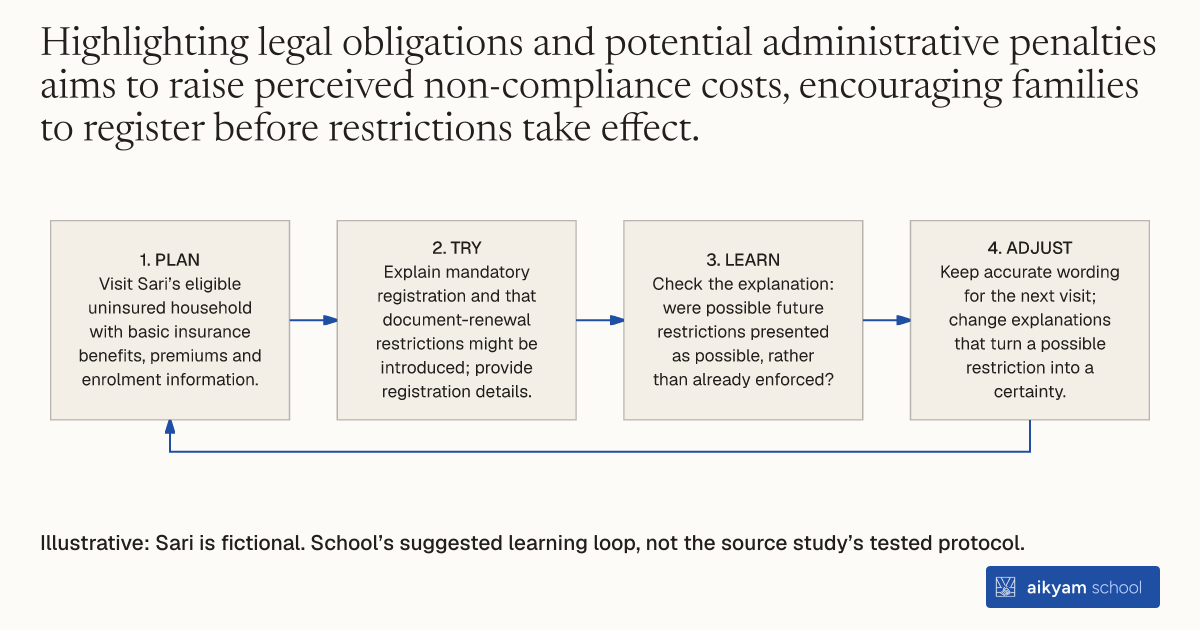
Try, learn and adjust
Check mandate information keeps its uncertainty
- Plan: Visit Sari’s eligible uninsured household with basic insurance benefits, premiums and enrolment information.
- Try: Explain mandatory registration and that document-renewal restrictions might be introduced; provide registration details.
- Learn: Check the explanation: were possible future restrictions presented as possible, rather than already enforced?
- Adjust: Keep accurate wording for the next visit; change explanations that turn a possible restriction into a certainty.
Illustrative: Sari is fictional. School’s suggested learning loop, not the source study’s tested protocol.
See source →School’s suggested, untested learning loop. Observe mandate and possible-sanction information; the study’s 0.4 percentage point enrolment change was not statistically significant.
How
When to use
Uninsured informal-sector households often fail to enroll in public health insurance due to weak mandate enforcement and low awareness of health coverage laws. Reminding households that insurance is legally mandatory and flagging potential government document renewal sanctions attempts to boost voluntary compliance without providing subsidies.
Deliver structured information reminding households of social health insurance laws and potential civil document sanctions during household visits.
- Target eligible uninsured informal-sector households during routine community enumerator visits.
- Provide basic oral and printed material detailing national health insurance benefits, enrollment steps, and monthly premium prices.
- State explicitly that public health insurance registration is legally mandatory for all citizens under national law.
- Warn households that the government may implement regulations requiring proof of health insurance to renew key civil documents, such as driver's licenses or passports.
- Provide local registration details and encourage families to complete enrollment to comply with state requirements.
Example
Enumerators delivered a mandate information script to uninsured informal households in Bandung, Indonesia, reminding them of insurance laws and potential passport or driver's license renewal restrictions. The intervention increased Year 1 enrollment by a statistically insignificant 0.4 percentage points above the un-informed baseline of 12.3 percent.
About the study
Participants
4,550 uninsured non-poor informal sector households in Bandung, Indonesia.
Study Design
Randomized controlled trial comparing a legal mandate information treatment against a basic-information control group, evaluated via government administrative data over 12 months.
Results
Year 1 enrollment changed by 0.4 percentage points (not statistically significant, standard error 0.011) off a control baseline of 12.3 percent; positive effect sizes larger than 2.5 percentage points are ruled out.