Research steps
Screen uninsured informal-worker households
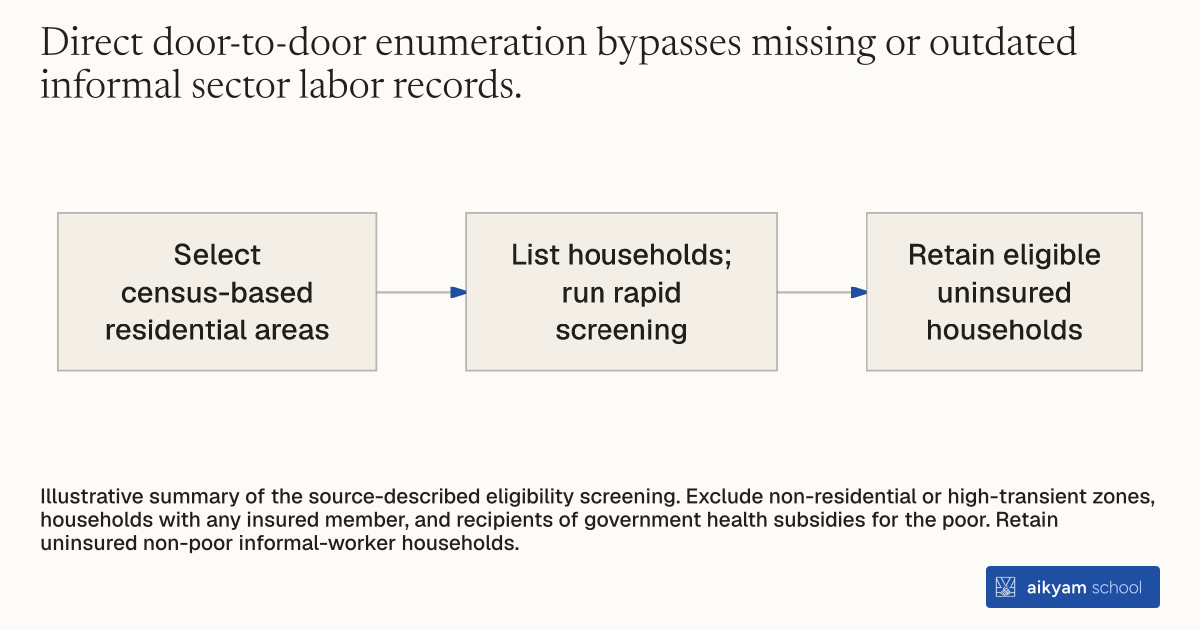
- Select census-based residential areas
- List households; run rapid screening
- Retain eligible uninsured households
Illustrative summary of the source-described eligibility screening. Exclude non-residential or high-transient zones, households with any insured member, and recipients of government health subsidies for the poor. Retain uninsured non-poor informal-worker households.
See source →How
When to use
Governments expanding public health insurance face difficulty identifying eligible informal-sector households who lack formal employer coverage and do not qualify for poor-targeted social assistance. Administrative records often lack complete data on informal workers, leading to misaligned outreach. Rapid door-to-door screening surveys systematically locate eligible beneficiaries across targeted urban neighborhoods.
Screen door-to-door households in targeted geographic areas using a rapid eligibility survey to identify uninsured non-poor informal workers.
- Select urban sub-districts and municipal neighborhoods with high concentrations of non-poor informal workers using census data.
- Exclude non-residential or high-transient zones such as university campuses, major shopping malls, and industrial factory sites.
- Deploy trained enumerators to list all households across the selected geographic units and administer a rapid screening questionnaire.
- Filter out households where at least one member already holds formal health insurance coverage or receives government health subsidies for the poor.
- Retain households where working members operate in the informal sector and currently lack any health insurance coverage.
Why it works
Rapid filtering ensures program resources reach only un-enrolled, non-poor households eligible for contributory coverage.
Example
Enumerators administered a rapid eligibility listing survey to 52,584 listed households in sampled urban neighborhoods across Medan and Bandung, Indonesia. The screening identified 7,629 target households meeting informal and uninsured criteria, yielding a 14.5 percent eligibility rate. After cross-referencing government databases to drop previously insured households, 5,996 eligible households entered the study sample.
About the study
Participants
52,584 listed households screened across urban sub-districts in Medan and Bandung, Indonesia.
Study Design
Geographic sampling based on census data followed by door-to-door rapid listing surveys and administrative data matching.
Results
14.5 percent of listed households (7,629 out of 52,584) met target population criteria of being uninsured, non-poor informal workers. Administrative matching removed newly subsidized households, resulting in a final eligible baseline sample of 5,996 households.