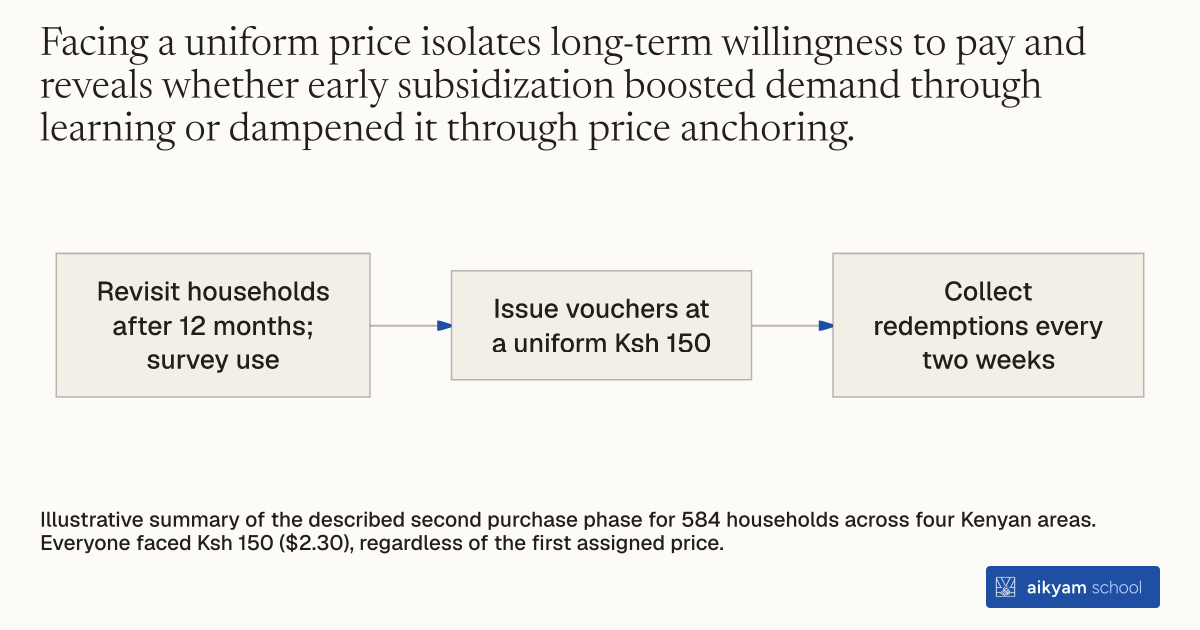
Research steps
Measure repeat purchases after one year
- Revisit households after 12 months; survey use
- Issue vouchers at a uniform Ksh 150
- Collect redemptions every two weeks
Illustrative summary of the described second purchase phase for 584 households across four Kenyan areas. Everyone faced Ksh 150 ($2.30), regardless of the first assigned price.
See source →How
When to use
Programs and researchers need to evaluate whether temporary introductory subsidies foster long-run adoption or create price anchoring that suppresses future demand. Offering a second purchase opportunity at a uniform unsubsidized price across all initial subsidy groups directly tests willingness to pay over time. This method allows evaluators to determine whether initial price discounts encourage repeat purchases through experiential learning.
Re-offer a previously subsidized health product to target households at a single uniform price one year after initial distribution to measure long-term willingness to pay.
- Re-visit all sampled households 12 months after the initial voucher distribution.
- Administer a long-run follow-up survey recording product retention, physical usage, and self-reported health outcomes.
- Distribute a second discount voucher redeemable at the same local partner retail shop.
- Set identical, unsubsidized voucher prices across all households regardless of their original assigned Phase 1 subsidy level.
- Collect redeemed voucher stubs and shop receipt logs every two weeks to compare secondary purchase rates across initial price groups.
Why it works
Holding the second-period price constant across all households controls for market conditions while exposing differences in valuation driven by prior product experience.
Example
In rural Western Kenya, researchers re-offered Olyset bed nets to households at a uniform price of 150 Ksh ($2.30) one year after initial randomized subsidies; households that received high initial subsidies (paying Ksh 50 or less) had a 15.8 percent purchase rate compared to 9.0 percent among lower subsidy recipients.
About the study
Participants
584 households across four rural enumeration areas in Busia District, Western Kenya.
Study Design
Two-stage randomized experiment re-issuing a second bed net voucher at a uniform Ksh 150 ($2.30) price 12 months after Phase 1 randomized prices.
Results
Households receiving high Phase 1 subsidies (price <= Ksh 50) were 6.8 percentage points more likely to purchase a second net at Ksh 150 than low subsidy recipients (15.8 percent vs 9.0 percent), representing a 49 percent relative increase in willingness to pay.